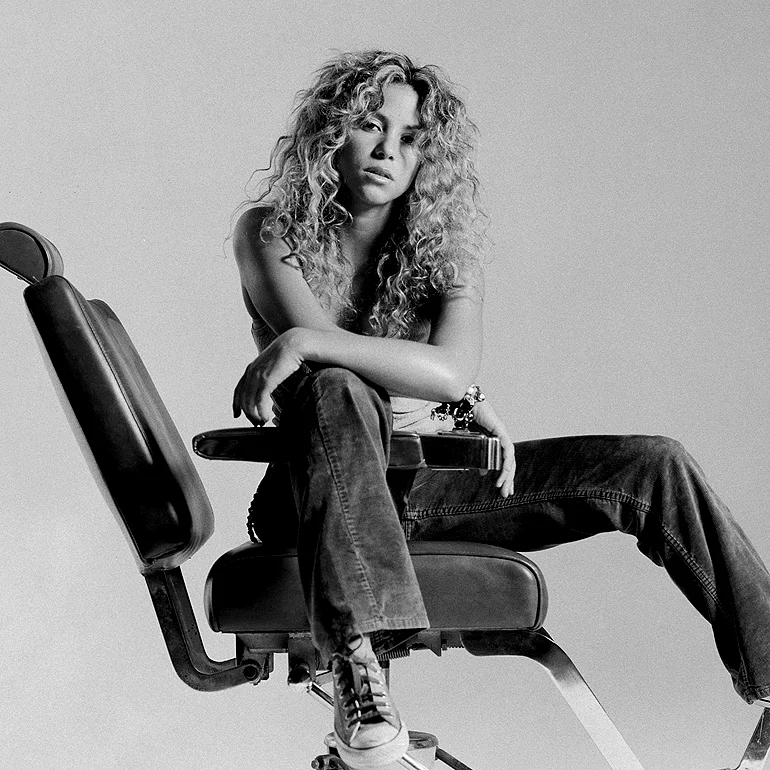
Across three decades, Shakira’s career has never been defined by a single genre, language, or market but by her ability to move between them with authorship intact. From her earliest records, where voice was treated as novelty, to her most recent work, Shakira has negotiated the tension between visibility and control with rare precision. What began as a career shaped by misreading evolved into a catalogue that made room for contradiction: emotional density and rhythmic clarity, political metaphor and viral moments, regional texture and global scale.
What holds this arc together is a specific form of reinvention: recalibration. Each record meets the market on its own terms, but rarely completely surrenders to it. When she moves into English, the writing resists flattening. When she embraces reggaetón, the voice remains distinct. This is not an artist who disappears into trends. It is one who tests whether they will hold her.
Industry dynamics shift. The market fragments. The platforms change. But Shakira adapts without dissolving. Her crossovers do not erase her identity. Her returns are rarely nostalgic. What she offers is not a fixed self, but a self in negotiation — with genre, with audience, with power. That negotiation has made her not just a pop star, but a case study in global authorship: what it means to write across languages, to be styled for export and still retain perspective, to be framed and still reinvent yourself from within.
And if there is a throughline in this catalogue, it is not only sound. It is authorship. Whether hidden, obscured, clarified, or shouted, Shakira’s writing remains central to how she holds space in an industry that often prefers image over voice. Even when that voice becomes viral, even when it sharpens into surface — it is hers.
Shakira’s legacy, then, is not simply her longevity or her hits. It is the structure she helped build: a space in which Latin American women artists can write, perform, and be received globally as full participants. She did not wait to be translated. She wrote until the market learned how to listen. And that, more than any single album, is the precedent she leaves behind.
Magia – The Frame of the Prodigy
Shakira’s debut album Magia, released in 1991 when she was just 13, is often framed as a footnote — an early record that predated her “real” career. But its existence reveals a more telling industry dynamic. Written largely by Shakira herself, the album contained songs she had composed since childhood. But that authorship wasn’t presented as craft. It was marketed as precocity. The emotional tone — which could have made her relatable to other children — wasn’t part of the pitch. What the industry sold was the image of a prodigy. And that difference flattened the work before anyone had time to hear it.
The language around Magia wasn’t about music. It was about promise. And promise, in this case, was positioned as a spectacle of youth: polished, poised, and already productive. The fact that she was signed by Sony Colombia (the only major record company in Colombia at the time) at such a young age was treated as impressive because of her age. No one questioned what place a thirteen-year-old had on national television — or whether visibility at that stage was a form of exposure more than the development of artistry. The implication wasn’t “here is a young songwriter.” It was “look how young she is to be doing this.”
Magia sold poorly. But the failure wasn’t structural. It was personalized. Rather than rethink the framing, the industry pulled back. But what Magia reveals, more than a debut, is a misreading of process. This was a moment that should have been protected — time for A&R development, lyrical exploration, and creative formation. Instead, it was marketed. This was exposure. And in an industry that often rewards visibility over growth, Magia stands as a case of child labour framed as spectacle — a catalogue delivered before the frame was ever built to hold it.
That logic wasn’t exclusive to Shakira. In the late 1980s and early 1990s, record labels across markets — from Latin America to East Asia to the U.S. — began signing children and teenagers not to develop them, but to frame them as already arrived. It wasn’t artist cultivation. It was short-cycle spectacle. Aaliyah was 14 when she released her debut on Blackground Records. BoA was discovered at 11 and became a pan-Asian export before adulthood. In each case, the industry didn’t just gamble on youth. It built around it — accelerating visibility, compressing formation, and styling childhood as market-ready.
In that context, Magia becomes more than a debut. It becomes an artifact of how the music industry treated kids as a category. The idea that a team of executives could steer, package, and promote a full-length record around a thirteen-year-old — rather than protect her time, build the foundation, and allow her voice to grow — exposes the core violence of the system. It wasn’t just a misstep. It was a strategy. And that strategy wasn’t built to last. It was built to launch.
The production on Magia is cautious — lightweight Latin pop filtered through major-label restraint. Soft keyboard beds, drum machine loops, and inoffensive melodic lines form the bulk of the arrangements. It isn’t bad. But it isn’t built to hold attention. The sound is flattened — clean, polished, and unmemorable. Magia doesn’t sound like a young artist discovering her voice. It sounds designed not to confuse the market — even if the product itself never quite makes sense.
That early presentation bleeds into the lyrics as well. Shakira reportedly wrote the songs herself — and even if some of the themes feel simplified, the writing shows form. Songs like “Gafas oscuras” and “Esta noche voy contigo” aren’t remarkable because of their youth. They’re remarkable because they’re songs: structurally complete, emotionally legible, melodically coherent. But the record doesn’t showcase that craft. This isn’t the album of a girl being developed. It’s the album of a girl already being sold.
In interviews, Shakira would later suggest that Magia didn’t reflect her — not creatively, not vocally, not emotionally. That, too, is telling. The first project in her catalogue isn’t an entry into artistry. It’s a detour shaped by someone else’s timeline — someone else’s idea of what marketable talent should look like at thirteen. The album that should have been her developmental space became the first step in a process she’d later have to reclaim.
What Magia offers, in retrospect, isn’t a minor release. It’s a structural record: a blueprint of how early authorship is noticed but not nurtured — especially when performed by a girl who wrote her own songs before the industry had learned how to listen to them.
Peligro – The Interruption of Authorship
By 1993, Colombia’s pop landscape was grounded in tradition without being static. Genres like cumbia, vallenato, and salsa still dominated the market, but they were being rearranged. Carlos Vives had just released Clásicos de la Provincia, a reframing of vallenato through pop-rock instrumentation that sold over a million copies in Colombia alone. Aterciopelados debuted with a sound that folded punk, folk, and rock into a local register. These artists were resonant with the culture. They drew from collective memory while breaking genre form, and in doing so, they created records that belonged to no single demographic. Children heard them in households. Adults played them in cars. There was no separation between youth and general visibility — no need for it. In that context, music wasn’t sliced by age group. It was arranged by genre, and by what moved.
If Magia was framed as precocity, Peligro was positioned as polish. But the market it was aiming for didn’t exist — not locally. In Colombia, there was no infrastructure to support a teenage pop record unanchored in regional genre. Music for youth existed, but not as a category. It was absorbed through family listening, filtered through radio formats that weren’t age-coded. Rock and balada were accessible to teenagers, but they weren’t marketed to them. In that landscape, Peligro had no foothold. It wasn’t rooted in traditional form, nor was it aligned with the emerging alt-rock movement. It gestured toward North American teen pop formulas — big melodies, surface-level intimacy — but without an audience trained to receive it.
Sony Colombia had misread the problem with Magia. It wasn’t that the songs lacked sheen. It was that the project lacked a solid root. Peligro doubled down — glossier production, tighter arrangements, fewer songs written by Shakira herself. But what remained was a product with no clear addressee. The record didn’t land because it had nothing to land on. There was no structure for it to stretch into, no strategy to scale it. What Peligro lacked wasn’t ambition. It was alignment.
Peligro was not just mismatched sonically. It was misaligned at the level of authorship. Most of the songs were not written by Shakira, and it shows. What is being expressed is not experience. Shakira had written most of Magia, but on Peligro, her pen is almost absent. The perspective is generic — and often male. The result is a collection of ballads written about a teenage girl, sung by one, but never fully owned by her.
That absence matters. What made her later albums resonant was not just the sound — it was the voice inside the writing. On Peligro, that voice is silenced. The writing becomes something to perform, not experience to share. And when that happens, what is lost is connection. The songs fail to resonate because they are not situated. Without authorship, the emotions do not land. They feel styled.
What Peligro lacked musically and structurally, it also lacked in reach. There was no clear rollout, no sustained campaign, and no moment where the songs could be heard in context. In contrast, Shakira’s visibility would come not through an album, but through television. Her acting role in the telenovela El Oasis, which began airing shortly after Peligro’s release, placed her in front of a national audience. Not as a singer, but as a presence. And that presence would do more for her recognition than the album ever could.
The songs on Peligro never circulated. They were not authored by her, and they were not promoted through her. What El Oasis offered was not just screen time. It was familiarity. Shakira’s voice, image, and persona were now in Colombian homes — not through a ballad cycle, but through scripted storytelling. It is telling that the album with her name on it went unheard, while the scenario she did not write placed her in public view. The imbalance of authorship remained. But the medium changed.
After Peligro, Shakira stepped back. Not with a press release or a label-framed hiatus, but with quiet deliberation. She left the industry temporarily and returned to high school. It was not a disappearance. It was a redirection — one she orchestrated herself. In doing so, she created the space that Sony had failed to give her: a period of development, unmarketed, unspectacular, and essential.
That decision matters. Because what followed — Pies Descalzos, and the career it made possible — was not a product of sudden reinvention. It was a return on time invested. What Peligro never allowed was authorship. What the break created was authorship as structure. She re-entered with songs she wrote, themes she chose, and sounds that fit no one’s mold but her own. The pause was not passive. It was a refusal — to be styled, to be misread, to be circulated before the voice had been shaped.
Pies Descalzos – The Regional Breakout
By 1995, Colombia’s pop music landscape was not organized around artistic discovery — it was built on recognizability. Acts who charted were not always the most musically original, but the most visible: television actors crossing into music, or figures tied to pre-existing cultural networks. Margarita Rosa de Francisco, already a national name through the telenovela Café con aroma de mujer, topped the charts with the show’s soundtrack. Alejandro Martínez, another actor, followed a similar path. Even Charlie Zaa, though not yet a household name, was already positioned through ties to Grupo Niche and the bolero-pop infrastructure around him. The system was not hostile to new music — but it did not create space for it without context. What moved was what had already circulated. And in that landscape, youth-pop as a category had no foothold. Visibility preceded viability.
Shakira entered that system without a platform. Her first two albums had failed to land. She had no industry lineage, no legacy ties, and no built-in visibility beyond her brief television role in El Oasis. But in 1994, something shifted. “¿Dónde Estás Corazón?,” originally released as part of a Sony Colombia compilation, began to circulate. It was not a high-stakes single. But it moved: on the radio, in households, and in stores. The track was clean pop rock — emotionally focused, vocally articulate, and structurally sharp. It did not lean on novelty. It leaned on craft. And for the first time, a song written and performed by a young woman outside of legacy frameworks found traction. That success gave her leverage. Her third and final contracted album with Sony would be hers to shape. But it would also be her only shot.
What followed was not just an album. It was an adaptation to who the artist was. Pies Descalzos was released in Colombia, but Sony quickly restructured its strategy around regional distribution. The project would move through Latin America — not as a local product, but as a pan-Latin offering. The logic was clear: Colombia’s market alone could not sustain a long-term breakthrough. But across Latin America, the climate was shifting. Mexico was producing pop acts outside of the telenovela-industrial complex. Argentina was leaning into youth-driven rock and alternative scenes. Shakira’s sound — a blend of alt-pop, soft rock, and Latin phrasing — had no clear national home. So, it travelled. Not as an export. As a fit.
The mid-1990s opened a small but important space for pop acts across Latin America who were not backed by media legacy or family presence. Artists like Fey, Sentidos Opuestos, and Imanol in Mexico were arriving without telenovela scaffolding. In that context, Shakira’s authorship made her singular: a young woman not just performing, but writing. Pies Descalzos was framed as work — structured songs, coherent production, and emotional literacy that positioned her as neither child star nor performer-for-hire. Colombia had no template for that sound. But by moving the record through multiple markets, Sony created a visibility strategy outside the usual channels — a soft launch with continental stakes.
Gone was the teenage gloss of Magia or the polish of Peligro. The Pies Descalzos visuals aligned with what was legible among youth in the mid-1990s: earthy palettes, stripped styling, and bohemian cues. It was not fashion-forward. But it was culturally aligned. The photography, the costuming, and the packaging all avoided excess. Shakira was styled as familiar. And that mattered. The visuals did not invent a persona. They clarified one — young, introspective, and not yet fully claimed.
What grounded Pies Descalzos was not just its tone — it was its scope. The album covers romantic themes, but avoids cliché. It stretches into irony, contradiction, resignation, and, in its final track, direct commentary. “Se Quiere, Se Mata” is not metaphorical. It is a song about abortion, written in coded but unmistakable terms. That kind of writing was rare in Latin American pop, and even more rare from a teenage artist. But it did not land as controversy. It landed as resonance. The songs were not structured to provoke. They were built to connect — with emotions already in circulation but rarely named in public. This was not youth pop shaped by innocence. It was youth pop shaped by authorship. And that made all the difference.
Vocally, Pies Descalzos does not showcase excess. It builds intimacy. Shakira’s delivery across the record is textured, but not ornamental. She leans into phrasing — not as performance, but as tone. There is a slight gravel in her mid-range, a clarity in the upper register, and a conversational tilt that carries emotional weight without dramatization. She does not belt to prove herself. That vocal presence is not built for spectacle. It is built for legibility — a voice shaped to hold thought, contradiction, and hesitation in equal parts. On songs like “Pies Descalzos, Sueños Blancos,” that delivery becomes structural: tone carries irony, breath carries tension. The voice does not overpower the writing. It sits within it.
Sonically, Pies Descalzos is built on a global register — but it is not imitation. The album blends soft rock structures, alt-pop phrasing, and occasional Latin rhythmic cues into something coherent but not clearly pinned. It does not chase a North American model, nor does it center Colombian genre codes. Instead, it borrows strategically: acoustic guitar patterns, mid-tempo drums, clean melodic arcs. The result is an album that feels accessible across markets without diluting its local voice. It does not stage hybridity. It lets it settle. That fluidity is part of what made it travel — not because it sounded international, but because it sounded like someone who understood how songs could carry across formats.
Pies Descalzos was not just Shakira’s breakthrough. It was the moment the industry recalibrated its expectations of her. The album’s success reframed her not as a teenage singer who had landed a hit, but as a songwriter with a distinct lyrical voice and a sonic register that could travel. Its resonance across Latin America was not accidental. It was authored. And that authorship — sharp, introspective, structurally clean — became the framework that would follow her. Pies Descalzos did not just mark the beginning of a new phase. It made her legible as an artist.
Dónde Están los Ladrones? – The Establishment of Authority
By the late 1990s, Latin pop was no longer a niche. Ricky Martin’s “María” had crossed into Europe and charted across Latin America. Enrique Iglesias was releasing bilingual material, and crossover moments were gaining traction — not only in the United States, but in international markets with no direct ties to the region. These artists moved with the infrastructure of major labels behind them, styled for global access, and framed less by lyrical complexity than by rhythmic clarity. What they offered was scale. What Shakira offered — at least for that moment — was depth.
By the mid-to-late 1990s, the conditions for a Latin pop crossover were unusually fertile. Global media conglomerates — including Sony, Universal, and BMG — had expanded their Latin divisions, investing heavily in acts that could travel across markets. Music television (MTV Latino, TeleHit, and eventually MTV España) had made visual rotation possible across language barriers. European markets, especially Spain and Italy, were increasingly open to Latin artists, not as niche imports but as pop figures. That shift was partially sonic — upbeat, percussive material like Ricky Martin’s “María” or Chayanne’s “Salomé” carried emotional legibility even when language wasn’t shared. But it was also structural. Crossover was no longer a gamble. It was a strategy — pre-planned, label-supported, and media-ready.
In that landscape, ¿Dónde Están los Ladrones? reads differently. It was not a crossover record. It was a consolidation. Where others pivoted toward English, Shakira doubled down on Spanish. Pies Descalzos had introduced her to the continent. Ladrones was built to hold that presence — and test its reach. There was no need to adapt to a market she had just entered. The work ahead was to solidify the one she had only just claimed. The album does not sound global by accident. It sounds precise because it had something to prove: not to the world, but to the region that had only just begun to listen.
Emilio Estefan’s name appears on ¿Dónde Están los Ladrones? not as a sonic architect, but as an executive anchor. He was not producing tracks. He was producing trust — or rather, its image. Estefan, already known for managing and producing Gloria Estefan’s crossover career and guiding acts like Jon Secada and Ricky Martin into U.S. Latin markets, symbolized legitimacy. His attachment to the project was not an intervention. It was a seal. For Sony, his presence made the album legible to stakeholders who saw crossover as the linear itinerary. Estefan’s reputation gave the project a buffer — the suggestion that Shakira’s work was now aligned with export, even as the music itself refused to dilute.
And that refusal is what makes the collaboration so precise. Shakira did not surrender her authorship. She maintained full writing credits, shaped the album with producer Lester Méndez and Colombian arranger Luis Fernando Ochoa, and kept the sonic architecture rooted in her own phrasing. But Estefan’s attachment allowed the work to move. It gave the label confidence without requiring her to compromise. He did not change the music. He changed its frame — making space in a system that might have otherwise required her to translate too early, or flatten the edges that made her voice distinct. The presence of Emilio Estefan signals more than commercial endorsement — it reveals where the expansion was pointed. ¿Dónde Están los Ladrones? was not aiming for a full international crossover. It was aiming for consolidation within the Latin market, including the Spanish-Speaking market of the United States. The strategy was precise: strengthen her hold on her existing public without compromising the core of her appeal — her writing. A crossover to non-Spanish-speaking markets would have required a shift in language, tone, and lyrical density. And that was not yet negotiable. Shakira’s power came from authorship. To remove the language was to undercut the structure.
The goal, then, was depth, not breadth. Estefan’s presence made the album scalable — ready for visibility in U.S. Latin charts, Miami radio, and Spanish-language media across the continent. But the music stayed rooted. There was no linguistic softening, no stylistic translation. The lyrics remained central, dense with metaphor, irony, and emotional detail. It was not global-pop Spanish. It was writer’s Spanish — rhythmic, layered, and unbothered by legibility outside the intended audience. What Shakira was building was not just a record. It was a relationship — with the listener who could already read her. The crossover could wait. The catalogue came first. Estefan did not guide the record’s sound. He guided its permission.
¿Dónde Están los Ladrones? does not offer spectacle. It offers density. The writing is elevated, but not abstract — detailed without being ornamental. Where Pies Descalzos showed promise, Ladrones confirms authorship. The lyrics move between emotional clarity and literary precision: “Inevitable” confesses through understatement; “Tú” stretches love into surrender; “Octavo Día” reframes theology into political metaphor. Nothing here is framed for ease. The songs resist surface reading. Instead, they rely on linguistic rhythm — interior rhyme, enjambment, and sentence structure that draws from poetic form. The result is a catalogue of perspectives. Even the title — a reference to a stolen suitcase of lyrics — becomes metaphor: authorship taken, then reasserted through the very act of recording.
Visually, Ladrones reimagines the earthy, bohemian styling of Pies Descalzos and moves toward grit. The album cover — industrial, textured, almost desaturated — places Shakira in a setting closer to protest than to performance. The pink hair, the minimal makeup, the direct gaze — all point toward a framing that resists polish. This was not soft pop. It was authored pop, structured by mood rather than market logic. Sonically, the album follows that frame. The production leans into clean instrumentation: electric guitar lines, sharp percussive cuts, restrained bass. There is no excess. Even when songs stretch emotionally — as in “No Creo” or “Ciega, Sordomuda” — the arrangements stay legible. The influences are wide — alt-rock, Latin pop, soft folk — but they are not stitched for eclecticism. They are focused, coherent, and shaped by the voice at their centre. The result is not hybrid. It is clear. ¿Dónde Están los Ladrones? is not trying to prove genre range. It is proving authorial tone.
The impact of ¿Dónde Están los Ladrones? was immediate — not as crossover, but as consolidation. It did not reinvent Shakira. It confirmed her. The album debuted at the top of the Latin charts, earned critical praise, and solidified her as a writer capable of scaling both intimacy and critique. But its legacy lies in more than accolades. It reframed what Latin pop could look like when led by a young woman writing her own terms. At a time when the genre was gaining visibility through spectacle and performance — often stylized through male-driven production and international packaging — Shakira positioned herself through authorship. Ladrones did not dilute its language for access. It deepened it. The fact that it was fully in Spanish, and still managed to chart globally, made it an outlier — not because of its language, but because it was heard anyway. The album proved that precision could travel. Not despite its rootedness, but because of it.
Laundry Service – Tension in Translation
By 2001, the Latin pop crossover had become a visible industry strategy — but one shaped almost entirely through male figures. Gloria Estefan and Selena had laid the groundwork in earlier decades, but the late 1990s solidified a new approach: curated exports. Ricky Martin, Enrique Iglesias, and Marc Anthony each transitioned to international visibility through calculated shifts in language and sound. Their albums included English tracks, pan-genre production, and visuals styled for global legibility.
Shakira arrived as a rare female candidate for this kind of expansion. She had already established herself as a central figure in Latin pop through Dónde Están los Ladrones?, with both critical acclaim and regional commercial power. But she was not yet global — and she had not yet been styled for it. That changed with her alignment to Epic, the label that had launched Jennifer Lopez’s On the 6 and had begun to experiment with a Latin-leaning crossover. On paper, Shakira was ideal: young, established, distinctive, and fluent in her own authorship.
Laundry Service was not just an album — it was an introduction. For global audiences unfamiliar with Shakira’s earlier work, it functioned as a debut. And like any debut, it was curated. To present her to non-Spanish-speaking listeners, certain choices were made: a more physical visual language, a simplified lyrical tone, and an emphasis on hooks over metaphor. But it was also a bilingual release — not just in voice, but in structure. Servicio de Lavandería, its Spanish-language counterpart, preserved part of her base, ensuring that the transition did not come off as departure. The rollout reflected that dual aim. Singles were not universally distributed; they were market-specific. “Te Dejo Madrid,” for instance, was pushed in Spain and Latin America — not in English-speaking territories. “Underneath Your Clothes” and “Objection (Tango)” were tailored for U.S. and European audiences. This was not a single narrative. It was a split-screen strategy — keeping the door open in both directions, hoping each audience would walk through.
The visual language of Laundry Service did not abandon the Shakira who made Pies Descalzos and Dónde Están los Ladrones? — it reframed her. The bohemian codes remained, but they were recalibrated for international recognition. Her hair — now bleached blonde but streaked with dark undertones — preserved a trace of the visual identity she had shaped regionally. The clothes followed a similar logic: low-rise pants, cropped tops, earth tones, and layered accessories echoed her earlier styling, but leaned more openly into sensuality. There was movement, midriff, and fluidity, but not high fashion — no couture silhouettes or editorial distance. Instead, she was styled to walk the line between the accessible and the “foreign”: relatable to her existing base, but legible alongside global pop figures. It was not a costume, but it was a performance — of Latinness, of womanhood, of authorship repositioned in the frame of export. Not fully erased. Just rewritten to circulate.
The sound of Laundry Service was not a reinvention, but it was an intentional expansion. Shakira retained the pop-rock foundations she’d perfected in Pies Descalzos and Dónde Están los Ladrones?: the emotional phrasing, the melodic guitars, the elastic vocal style—but she now integrated clear, strategic global references. « Whenever, Wherever » drew explicitly from worldbeat influences, incorporating Andean pan flutes and rhythmic structures designed to resonate beyond her earlier base. « Objection (Tango) » directly interpolated Argentine tango into a pop-rock frame, highlighting familiar cultural motifs but making them easily recognizable to international listeners. These were deliberate additions, meant not just as flourishes but as sonic translations—choices made to clarify rather than obscure. The album was not designed purely to preserve a legacy; it was built to open it up, grounding Shakira in global pop while clearly signalling the Latin American roots she never abandoned.
The lyrical voice on Laundry Service is defined by a bilingual split. In Spanish, Shakira’s writing remains confident, introspective, and precise—continuing the poetic density she had developed on earlier albums. Songs like « Te Dejo Madrid » show her Spanish-language writing at its sharpest: emotionally layered and carefully structured. In English, however, the lyrics become notably quirkier—more playful, sometimes awkward, frequently humorous. Lines such as « Lucky that my breasts are small and humble » are neither accidents nor mistranslations; they were stylistic choices, moments of deliberate linguistic eccentricity designed to render her more accessible to an international audience. Rather than diluting her image, this humoristic awkwardness reinforced it, positioning her as approachable, relatable, and distinctly human within the high-gloss pop landscape. It was a recalibration of tone—less polished but strategically endearing—preserving her authorship while broadening its reach.
The reception of Laundry Service was massive but divided. Commercially, it sold over 13 million copies, effectively positioning Shakira as a major global pop figure. Yet, critical responses varied: some praised her ability to maintain authorship and authenticity within a crossover framework, while others critiqued the simplified English lyrics or the highly stylized visuals as compromises. Nonetheless, the album’s legacy was unmistakable. Shakira’s strategic bilingual approach set a new standard for Latin American pop artists seeking international recognition. Soon after, artists like Thalía and Paulina Rubio emulated aspects of Shakira’s blueprint to crossover. While these artists found varying degrees of success, none matched Shakira’s impact, which was defined not only by commercial results but by the deliberate, careful balance she struck between translation and preservation of artistic identity. Laundry Service reshaped the crossover conversation, ensuring that future attempts at international markets would always measure themselves against the nuanced path Shakira had carved.
Fijacion Oral, Vol. 1 – The Return of Fluency
In 2005, the global music market remained firmly oriented toward English-language pop. The largest hits and best-selling albums were still predominantly delivered in English, structured around Anglo-centric hooks and lyrical clarity. Yet, subtle cracks had started to appear in this monolithic landscape. Acts like Il Divo’s multilingual, operatic pop had successfully reached international audiences without linguistic adjustments, quietly preparing the market’s ear for greater linguistic diversity. Simultaneously, the rapid mainstreaming of Caribbean-inflected club music—reggaeton and dancehall fusion tracks from artists like Daddy Yankee, Nina Sky or N.O.R.E.—pointed to a growing openness to non-English genres. However, these songs were largely positioned as club anthems rather than authored pop projects. Into this shifting space, Shakira released Fijación Oral, Vol. 1: not a dance record, not a crossover compromise, but a fully Spanish-language pop-rock album anchored by careful authorship and introspective lyricism. Rather than capitalizing on novelty or rhythmic familiarity, she leaned on cultural and emotional depth, testing whether global markets were ready to move beyond mere rhythm.
Fijación Oral, Vol. 1 did not follow the logic of crossover. It reversed it. After the global success of Laundry Service, Shakira had access to every commercial path typically offered to artists in her position: English-first releases, image expansion, sound simplification. Instead, she delivered a Spanish-language album first — not as a side project or a gesture to her base, but as a central release. That decision was not just unusual. It recentred the terms of visibility. She did not wait to be translated back. She began in the language she had started with — and asked the market to follow. The move was not framed as cultural maintenance. It was presented as scale. No disclaimers. No explanations. Just Spanish, fully written, fully arranged, and fully distributed. The message was clear: she was not crossing over to stay. She was circling back to expand. And in doing so, she made authorship in Spanish legible at a commercial tier where it had rarely been seen before — not as compromise, not as tribute, but as central.
The visual language of Fijación Oral, Vol. 1 pulls away from the golden-filtered exoticism of Laundry Service and moves toward something quieter — and more grounded. The high-gloss sensuality is replaced with something closer to intimacy. In the “La Tortura” video, Shakira appears stripped of the pop star costume: minimal makeup, dim lighting, sweat rather than shimmer. It does not perform naturalness. It inhabits it. There is no theatrical attempt to represent “Latinness” as mood or rhythm. Instead, her body — and by extension her identity — is returned to context: a Latin American woman articulating private wounds without turning them into spectacle. The styling is less about legibility and more about ownership. Rather than being framed for global audiences, she presents herself as part of the world she is singing from. Not a projection. A participant. Fijación Oral does not erase image. It repurposes it — not as surface, but as setting.
Sonically, Fijación Oral, Vol. 1 is more mature — not because it is slower or softer, but because it is shaped. The album is cohesive. There are no clear centrepieces or outliers. Instead, the songs sit side by side in tone and intention: rooted in Latin pop but textured with specificity. Cumbia, bossa nova, Colombian folk, and soft balladry are folded into a palette that feels regional without being nostalgic. There are flourishes — accordion, strings, layered harmonies — but they do not distract. They build. Unlike Laundry Service, which scattered its sound to match a new scale of audience, Fijación Oral keeps the scale small. The production is tight, the writing is legible, and the emotions are grounded. This is not crossover through spectacle. It is coherence — a body of work that presents her cultural references not as seasoning, but as form.
Lyrically, Fijación Oral, Vol. 1 feels both deliberate and intimate. The reduced tracklist suggests intention behind the songs that are part of the album. The writing leans into contradiction — love framed as hunger, doubt rendered as desire, intimacy. There is no attempt to universalize the emotion. Instead, it stays close: specific images, domestic metaphors, half-explained feelings that trail off. They present feeling as the structure upon which the album is built. The tone is confident, but not distant. What emerges is not vulnerability as performance, but authorship as design: love songs that refuse neatness, sung in a voice that never asks to be softened.
Fijación Oral, Vol. 1 marked a shift not only in Shakira’s catalogue but in the framework of global pop. It proved that a fully Spanish-language album — authored, specific, and stylistically intact — could perform at the highest commercial level without translation or dilution. It was not positioned as a side project or cultural gesture. It was the first instalment of a global campaign, and it arrived first. That order mattered. It re-centred the Spanish language in her public work and showed the industry that Spanish did not have to be a limit. It could be the draw. In doing so, Fijación Oral, Vol. 1 expanded what was structurally viable for a Latin American artist working internationally. Its success created the space for future projects — Sale el Sol, El Dorado — to be released on their own terms, in Spanish, without requiring explanation or compromise. The album’s legacy is not just in its numbers. It is in the precedent it set: that language, when paired with authorship and clarity, does not need to be translated to be heard.
Oral Fixation, Vol. 2 – The Pop-Rock Ambition in a Non-receptive Market
By the time Oral Fixation, Vol. 2 was released, pop-rock had regained commercial centrality — but almost exclusively through masculine frames. Nickelback’s arena-driven grit, Keane’s soft piano-rock melancholy, and Robbie Williams’ theatrical swagger each offered a version of emotional accessibility filtered through male presence. The women breaking through were positioned differently. Avril Lavigne and Kelly Clarkson, both of whom had seen massive success in the years prior, were framed as pop-first — crafting songs with clean structure and just enough distortion to pass as “rock.” The genre’s borders had softened, but the gate remained guarded. Shakira arrived with an album that followed the architecture — guitars, propulsion, anthemic builds — but she was not part of the wave. She was adjacent to it. The sound landed in the genre, but the project was not received as central. It was allowed in. But it was not awaited.
If Fijación Oral, Vol. 1 was the Spanish-language record grounded in Latin pop and folk tradition, Vol. 2 was its English-language sibling — a project built to mirror, not just translate. The rollout was structured accordingly. “Don’t Bother,” the lead single, aimed for rock radio and crossover appeal, but the song’s moderate reception did not match the impact of “La Tortura.” The album opened soft. And for a global artist in a post–Laundry Service world, soft was not the plan. A reissue followed. “Hips Don’t Lie,” a collaboration with Wyclef Jean, was added and marketed as a standalone event. It worked. The single exploded, hitting number one in dozens of countries. But the pivot shifted the album’s frame. What began as a pop-rock project shaped to stretch her authorship was now anchored by a worldbeat anthem — one that, like “Whenever, Wherever,” reframed Shakira through movement, accent, and rhythm rather than language or authorship.
The original visual language of Oral Fixation, Vol. 2 carried over the aesthetic of Vol. 1 — minimal styling, low-saturation palettes, and hints of glamour. The “Don’t Bother” video presented a Shakira stripped of the golden gloss from Laundry Service — bare-faced, self-contained, and leaning toward the image of a woman not performing, but revealing. The album cover — a nod to Eve and original sin — hinted at something more conceptual: gender, temptation, authorship. But the subdued frame did not hold. With “Hips Don’t Lie,” the visuals shifted back toward the body: stylized dancing, vivid color palettes, hair as spectacle. The iconography returned — but brighter, bolder, and more familiar to global audiences. The recalibration was effective. But it marked a return to performance over proposition.
As a body of work, Oral Fixation, Vol. 2 remains fundamentally a pop-rock album. Tracks like “Don’t Bother,” “Animal City,” and “Hey You” lean into guitars, sharp percussion, and narrative build. But the album’s commercial identity was eventually tied almost entirely to “Hips Don’t Lie,” which bore little sonic or lyrical resemblance to the rest of the project. The same happened when “La Tortura” was included in the re-release. Both tracks are hits. But they function outside the album’s original tone. The record sold millions — over 3 million in the U.S. and more than a million in Europe — but the success did not reflect the internal consistency of the album. Instead, it revealed something else: the difference between what Shakira had composed and what the market chose to elevate.
Lyrically, Oral Fixation, Vol. 2 continued Shakira’s signature blend of density, and metaphor. The writing draws on biblical motifs — Eve, temptation, origin myths — but reworks them through contemporary emotion. Songs like “How Do You Do” directly address God, blurring the line between confession and confrontation. Others, like “Don’t Bother” and “Your Embrace,” spiral around heartbreak with a voice that is both theatrical and grounded. There is little simplicity. Her English remains idiosyncratic: sometimes overly formal, sometimes skewed in register, but always hers. The lyrics do not flatten for clarity. They layer. And in doing so, they resist the notion that crossover requires dilution.
Oral Fixation, Vol. 2 is often remembered for its pivot — from underperformance to global hit. “Hips Don’t Lie” became the kind of song that rewrites an album’s history. But the project underneath that single remains a strong — if overlooked — entry in her catalogue. Critics were divided. But what it revealed was the tension of global stardom: the pull between authorship and expectation, between coherence and visibility. Shakira did not fail. She changed her target. And Vol. 2 stands as the moment that recalibration became part of her career’s structure — not a break, but a strategy.
Oral Fixation, Vol. 2 was not supposed to be about legibility. It followed Fijación Oral, Vol. 1, a Spanish-language album released at the height of her international visibility — a decision that itself pushed against the idea that global artists must pivot toward English to remain viable. The English counterpart, by contrast, was built as a pop-rock project: guitars, layered production, emotionally structured writing. But the album did not land. It was only when Hips Don’t Lie was added to a re-release that the project found traction — not because it clarified the album, but because it clarified her. That single was rhythm-forward, visually stylized, and built around the version of Latin identity most legible to the global marketplace: sensuality, rhythm, movement. The body became central again — not by accident, but by design. Shakira was embodying cultural familiarity. It was not erasure. But it was a concession — a strategic pivot that said more about what the industry rewarded than what she lacked.
She Wolf – The Limits of the American Market
By 2009, pop had entered its electronic phase. The sound of the moment was compressed, synthetic, and heavily rhythmic — led by the global rise of EDM and its commercial adaptations: David Guetta, Lady Gaga, Flo Rida, The Black Eyed Peas. The charts leaned into automation and abstraction, with vocals processed, hooks sharpened, and intimacy stylized into futurism. She Wolf did not arrive as a reaction to that trend. It arrived inside it — but strangely shaped. The beats were tight, the sound palette was lean, but the vocal delivery was elastic, ironic, and often unconventional in tone. And unlike the standardized EDM pop of the time, Shakira’s choices leaned into contrast: disco-funk, Mediterranean synths, urban sounds and phrasing that moved unpredictably. The U.S. market did not follow. Even with several production slots from The Neptunes — whose names had anchored early-2000s radio — the album was largely ignored there, their name was not enough to guarantee success there. But in Europe and Latin America, it made sense. The project was not styled as pop precision. It was heard as experiment. In that context, She Wolf signaled a shift: her audience was still global, but it was no longer centralized.
She Wolf did not arrive as a follow-up to Hips Don’t Lie. It arrived as a proposition. Shakira responded not by following, but by offering her own version. She Wolf was not a return to worldbeat, nor a rehash of her pop-rock catalogue. It was a lean, urban electronic record with one goal: to enter the conversation on her own terms. The tracklist was short — 9 to 10 original songs depending on the edition — and tightly curated. Even the collaborations were targeted. “Give It Up to Me,” added late to the U.S. edition and featuring Lil Wayne with production from Timbaland, was a clear attempt to re-anchor her within the American market. But it did not land. The album’s performance in the U.S. was muted, despite its precision. And while “Gypsy” recalled her earlier acoustic textures, the rest of the album let go of the tropes that had made her legible to international audiences. This was not Shakira trying to blend in. It was Shakira asking whether she could pivot — and finding out the market was not fully prepared to meet her there.
The visual language of She Wolf was a rupture — stylized, minimal, and unapologetically constructed. Gone were the earth tones, the folk references, and the natural light. In their place: metallic cages, contorted poses, and directional lighting that framed Shakira less as a regional figure and more as a myth. The cover art — stark, with Shakira arched in a sleek bodysuit — felt deliberately artificial, almost chrome-like. The body, no longer linked to Latin iconography or bohemian codes, was now abstracted: posed, shaped. The “She Wolf” video extended that logic. Set in a futuristic space, it offered dance as transformation, not performance — a woman disappearing into movement that felt both stylized and animalistic. It was not meant to seduce through softness, nor to confirm legibility. It was meant to signal a new frame: pop persona as an aesthetic experiment. And that distance was intentional. The visuals did not return to earlier codes. They broke them — cleanly, vividly, and with full control.
Lyrically, She Wolf shifts away from the dense metaphors of earlier records and moves toward directness. The emotions are still present, but they are no longer explained through elaborate imagery. Instead, they are immediate — desire, restlessness, impulse. The title track presents a woman stepping out of routine, not with sadness, but with decision. Elsewhere, the lyrics feel sparse but pointed: “Why Wait” and “Did It Again” are not structured as stories, but as snapshots of attraction and repetition. The album avoids full narrative in favor of mood. There are still traces of her older voice — especially in the Spanish version of “Lo Hecho Está Hecho” — but the writing is styled for clarity, not layering. The songs try to name a feeling — quickly, rhythmically, and with just enough detail to land.
The reception of She Wolf was fragmented. In Europe and parts of Latin America, the album found a receptive audience: the lead single charted well, the visual language circulated, and the shift toward urban electro-pop felt legible. But in the United States, the album failed to anchor. Despite the addition of The Neptunes and a later re-release featuring a collaboration with Lil Wayne, the project did not generate the commercial momentum expected from its structure. Part of that failure was timing — EDM was rising, but still framed through certain pop aesthetics that Shakira did not fully embody. Part of it was framing — an album that leaned into electro minimalism and vocal eccentricity arrived with little context. She Wolf did not feel like a reinvention. It felt like a proposition — and one that went largely unanswered. Yet in retrospect, the album has aged with clarity. Its short tracklist, sonic coherence, and lyrical risk now read as restraint. It was not a global moment. But it was a self-styled chapter: bold, off-kilter, and uninterested in repetition.
Sale el Sol – The Strategic Grounding
By 2010, the limits of pop-EDM had begun to show. The genre, which had dominated radio for several years, was still producing hits — but not albums. The audience it attracted moved quickly: single-driven, playlist-oriented, and not anchored to artist loyalty. Sales reflected that shift. While EDM tracks filled the charts, the records that sold came from elsewhere. Alicia Keys, with her return to stripped-back pop-R&B, and Susan Boyle, through traditional balladry, moved units through familiarity, not trend. Artists who had leaned into the EDM frame found themselves recalibrating — either by returning to genre roots or by layering in sonic depth the formula could not provide. The club sound had reach. But it did not guarantee longevity. In that landscape, Sale el Sol arrived as re-anchoring — a multi-genre project that pulled Shakira back into authorship and regional legibility. Not as nostalgia. As re-foundation.
Sale el Sol is often framed as a return — but it is more accurately a repositioning. Rather than revisiting her earlier catalogue, Shakira expands it, working with forms that she had not previously centred. Merengue appears for the first time in her discography, not as pastiche but as fit — a rhythmic frame that carries her voice without irony or hesitation. Other tracks draw from folk-pop, acoustic balladry, and soft rock, but none rely on nostalgia. The palette is broad, but the tone is cohesive. This is not a patchwork of old selves. It is a consolidation of what remains legible. Coming off the global visibility of “Waka Waka (This Time for Africa)” — itself built from Afropop textures — Sale el Sol anchors her not in geography, but in adaptability. The sonic base is regional, but the reach is wide. What holds it together is more than genre. It is her presence in the sound.
The visual identity of Sale el Sol returns to the bohemian frame — but not as repetition. It is a recalibration for 2010: softer tones, loose silhouettes, unstyled curls, and textured backdrops. The golden glow of Laundry Service and the glamour of She Wolf are gone. This is not a nostalgic callback to Pies Descalzos. It is a matured version of the same instinct — less curated, more internal. Shakira is not performing eccentricity here. The visuals do not ask for global legibility. They ask for continuity. And in doing so, they present her not as a pop persona, but as a working artist — still visible, still stylistically fluid, but not rebranded. Just clarified.
Sonically, Sale el Sol is divided into three distinct zones — pop-rock, Caribbean rhythm, and ballads — but it never fragments. The structure is deliberate: tracks unfold as chapters rather than contrasts. The rock elements lean into her early alt-pop textures (“Devoción,” “Tu Boca”), with guitars sharpened but not theatrical. The Caribbean moments — merengue, reggaetón — emerge not as guest appearances, but as part of her voice’s expanded terrain. “Loca” and “Rabiosa” do not flatten into novelty. They situate her as fluent, not borrowing. And the ballads anchor the album’s centre — emotionally legible, vocally restrained, and framed without excess. This is not a playlist. The sonic shifts feel authored, not market-driven. And that cohesion — across genre, tone, and structure — is what makes Sale el Sol feel less like a return, and more like a re-grounding.
Lyrically, Sale el Sol opens space. Where previous albums often leaned into contradiction and metaphor, this record loosens the structure. The writing is still authored — personal, textured, deliberate — but it plays more with tone. Tracks like “Rabiosa” and “Loca” are built around teasing repetition and rhythmic flirtation, more gesture than confession. Even in their simplicity, they never feel generic; they feel styled. The voice is lighter, but not vague. Elsewhere, songs like “Antes de las Seis” return to lyrical depth — emotionally spare, tonally controlled, and anchored in restraint. What emerges is not a shift in her pen, but a widening of it. She allows herself irony, brevity, even humor, without sacrificing control. The result is an album that does not need to prove lyrical complexity in every bar. It trusts the writing — and the listener — to find meaning in tone as much as in structure.
Sale el Sol was not framed as a comeback, but it functioned as one. After the mixed reception of She Wolf, this album marked a recalibration — not a retreat into safety, but a return to grounding. Commercially, it performed well: debuting at number one on Billboard’s Latin Albums chart and reaching high placements across Europe and Latin America. Critically, it was read as a reset — a reminder of Shakira’s range, authorship, and cultural specificity. But what solidified the album’s legacy was not just its numbers. It was its clarity. Sale el Sol did not chase a frame. It built one. By splitting the record across three stylistic lanes — pop-rock, Caribbean rhythm, and romantic balladry — Shakira reasserted her own versatility without dilution. The album did not invent a new sound. But it created a new base: one that would allow her to shift again without fully departing. It held the catalogue in place — and reminded the market that adaptability could still be rooted.
Shakira. – Presence Without Disruption
By 2014, the pop landscape had fragmented. No single genre held dominance — instead, charts reflected a patchwork of forms: EDM still held club space, but so did stripped-down folk-pop, hip-hop, and glossy pop-R&B hybrids. The albums that moved units were anchored by hits. Katy Perry’s Prism, Pharrell Williams’s G I R L, and Taylor Swift’s 1989 each benefited from breakout singles that defined their commercial narratives. Visibility was mostly single-first; albums followed if the songs travelled. The year’s biggest pop moments did not come from cohesive projects — they came from individual tracks that shaped early streaming behaviour, radio play, and audience memory. In that climate, Shakira. did not arrive to clearly centre a vision. It arrived to stake presence. And the tools it used — high-profile collaborations and cross-market singles — reflected that logic. Not a reinvention. A re-entry, calibrated for an industry that no longer moved in one direction.
In that space, the high-profile collaboration with Rihanna became the centre of the album’s presentation. “Can’t Remember to Forget You” was Shakira’s highest-debuting single in the U.S., peaking at #15 — a visible but not dominant chart moment. Internationally, the song found more traction, reaching the top 10 in multiple markets and becoming one of the most-viewed music videos on YouTube at the time. But the album it introduced — simply titled Shakira. — missed certifications in both the U.S. and the U.K., despite her global name recognition. The performance revealed a shift: her English-language base, once central to her crossover, no longer guaranteed commercial traction. The release functioned more as a reintroduction than a return to form. The collaboration carried visibility. But the album did not carry through.
The visual identity of Shakira. was streamlined — polished, direct, and deliberately neutral. Gone were the layered textures of Laundry Service or the stylized myth of She Wolf. In their place: clean hair, minimal makeup, soft lighting. The album cover shows her seated with a guitar, barefoot, blonde, unadorned. It was not a return to bohemianism, but a presentation of artistic normalcy — as if reasserting the idea of Shakira as a singer-songwriter first. There is very little mystique here. No elaborate staging, no surrealist elements, no exaggerated sensuality. Just image, stripped of spectacle. And that shift matters. After years of visual experimentation and cultural play, Shakira. arrived framed in simplicity. The persona was not erased. But it was softened — reframed as recognizably “pop” without leaning into any archetype. The album did not push a new aesthetic narrative. It focused on legibility. And in doing so, it marked a pivot: not toward reinvention, but toward stabilization.
The sonic identity of Shakira. is built around a central core: pop. Not pop-rock, not world-pop, not genre fusion — just pop, with touches of reference. The album leans into familiar structures: midtempo grooves, acoustic flourishes, singable hooks. Its genre play is present, but subtle. There is a hint of reggae on “Cut Me Deep,” a nod to country on “Medicine,” a reggae influence woven through “Can’t Remember to Forget You.” But these are accents, not frameworks. The songs are built to be broadly accessible, not culturally specific. That is the throughline — accessibility over experimentation, ease over rupture. The record does not search for a new sound. It refines her place within existing ones. And in doing so, it becomes one of her most sonically conventional albums — not anonymous, but deliberately legible. A version of Shakira built to be heard anywhere, even if not held onto everywhere.
Lyrically, Shakira. marks a shift toward simplicity. The writing here is more declarative than metaphorical, more direct than layered. Gone are the elliptical phrases and coded emotional spirals of Fijación Oral or Dónde Están los Ladrones? — in their place are statements, clean and clear. Songs like “Empire” and “23” express devotion without disguise. “Cut Me Deep” and “Can’t Remember to Forget You” present heartbreak in plain terms. The wit remains — subtle irony, playful phrasing — but it is tempered by accessibility. What emerges is not a loss of voice, but a recalibration of it — a version of Shakira that speaks plainly, without surrendering control. Less introspective, more performative. Less tangled, more visible.
To date, Shakira. stands as her last album primarily in English — a project that does not mark a collapse, but a recalibration. It offered presence, not permanence. By 2014, the crossover space she had once helped define was saturated, and the global market no longer required translation to grant access. In that context, Shakira. felt transitional: a collection of pop songs shaped for recognition, not rupture. It held her voice, her image, her authorship — but in softened form, styled for alignment rather than disruption. The album did not redefine her. But it made one thing clear: English was no longer the only route to visibility. And Shakira, who had always used language as both platform and boundary, was beginning to turn back toward the one that made her.
El Dorado – Alignment Without Apology
By 2017, Latin pop was being reintroduced to the global market — not as crossover, but as centre. The tropical house wave of the mid-2010s had already warmed audiences to sun-kissed rhythms: tracks like OMI’s “Cheerleader” and Kygo’s early catalog blended electronic production with soft Caribbean inflections, turning summer into a sonic setting. But it was “Despacito” and “Mi Gente” that restructured the frame. These weren’t Latin-inflected pop songs. They were global hits sung entirely in Spanish — driven by reggaetón, dembow, and Afro-Caribbean cadence. Suddenly, Latin wasn’t a feature. It was the foundation. And El Dorado arrived in the middle of that shift: not to ride it, but to affirm it. Shakira wasn’t rejoining Latin pop. She had never left it. What changed was that the world was listening again.
Chantaje and Me Enamoré introduced El Dorado not with a return to rock, but with full alignment to the pop-reggaetón landscape already dominating the charts. Both songs were entirely in Spanish — fluent in tone, light in structure, and built for rotation. The Shakira of these singles was not reinvented. She was reframed: rhythm-forward, casually romantic, and tonally flirtatious. The shift was not abrupt. Many of her most enduring hits — La Tortura, Waka Waka, Loca — had already moved away from guitar-led balladry and into percussive play. What changed on El Dorado was the cohesion. There was no longer a need to balance between rock and rhythm. The lighter tones had always landed. Here, she leaned into them fully — not as compromise, but as clarity.
Sonically, El Dorado is not structured around reinvention — it is shaped by fluency. The production leans into what had become the commercial centre of Latin pop in the mid-2010s: reggaetón foundations, dembow rhythm, and stripped-back melodic toplines. Songs like Perro Fiel, Trap, and Chantaje are not genre fusions — they are genre entries. Shakira does not treat the form as a feature. She moves inside it. The beats are clean and the vocals are carried by rhythm more than harmony. Unlike Sale el Sol, which folded genres into a singer-songwriter frame, El Dorado lets the rhythm dictate tone. What emerges is not eclecticism — it is precision. The sound is contemporary, modular, and engineered for circulation. Not as a statement, but as fluency in a language she had helped introduce to the world — now spoken back to her.
Lyrically, El Dorado marks a soft recalibration. The themes are familiar — love, desire, memory — but the tone has shifted. Gone is the lyrical density of Fijación Oral or the sharp irony of Dónde Están los Ladrones?. What emerges instead is lightness, not in craft, but in affect. The songs are cleaner, more direct, shaped to travel rather than linger. Tracks like Me Enamoré and Chantaje center flirtation and emotional immediacy, structured around mood rather than metaphor. Even when she gestures toward interiority — as in Amarillo or Nada — the writing resists extensive elaboration. It sketches feeling rather than interrogating it. That simplicity is not a lack of authorship. It is a shift in purpose. El Dorado is not built to hold complexity. It is built to circulate. The intimacy is still there, but it is styled as atmosphere — emotion in motion, not in pause.
The visual language of El Dorado reflects the sonic shift. Gone is the dense choreography of Laundry Service, the folkloric textures of Sale el Sol, or the hyper-styled palette of She Wolf. In their place: filtered daylight, hand-held intimacy, pastel tones. Shakira appears in denim, loose blouses, natural curls, and minimal makeup — styled not to surprise, but to settle. The covers and promotional visuals align her with a quieter register of pop stardom: less theatrical, more relaxed. The golden filter of the album’s title is not a gilding — it is warmth. The visuals do not dramatize a return to Spanish. They normalize it. In that way, El Dorado is not a reintroduction. It is a confirmation — not of reinvention, but of alignment between image, language, and genre.
The legacy of El Dorado is not built on reinvention — it is built on timing. Released in 2017, the album landed at the precise moment Latin pop was re-entering the global mainstream. Hits like Despacito and Mi Gente had reconditioned audiences to the sound of Spanish on the charts, not as a novelty, but as centrality. In that climate, El Dorado did not feel like a pivot. It felt like placement. The record delivered Shakira’s most commercially cohesive work in nearly a decade, not because it expanded her authorship, but because it repositioned her in the flow of the market she once helped shape. It earned her a Latin Grammy, a Grammy, and strong chart performance across Latin America and Europe. But more importantly, it allowed her to re-enter global visibility not through crossover gestures — but by anchoring herself in the genre’s evolution. El Dorado confirmed what Laundry Service had first proven: Shakira could read the shifts. And this time, she did not need translation. She arrived already fluent.
Las Mujeres Ya No Lloran – Authorship and Reaction
By 2024, the pop landscape had fractured into currents — not genres. Streaming had dissolved the idea of a shared mainstream. Instead, artists moved through parallel lanes: hyperpop, regional Mexican, Afrobeats, K-pop, urbano, soft singer-songwriter, each with its own infrastructure, none dominating entirely. Chart logic was hybrid: hits went viral through TikTok before radio, and albums were no longer sequenced for play-through but engineered for reach. In that context, there was no one center — only visibility. And visibility required reaction. Las mujeres ya no lloran enters that field not to stabilize it, but to meet it. Shakira does not attempt to unify sound. She curates impact. The result is not a return to form. It is a return to scale — but through a new grammar.
The re-entry did not begin with an album. It began with rupture. Shakira’s collaboration with Bizarrap — BZRP Music Sessions #53 — was not framed as a single. It was framed as a statement. Lyrically direct, sonically minimal, and structurally engineered for viral pull, the track became a cultural event. TQG, her collaboration with Karol G weeks later, reinforced the frame: Shakira was not writing from distance. She was writing from aftermath. The tone was not confessional. It was observational — clear, cutting, and designed for impact. These tracks did more than circulate. They built anticipation. And more importantly, they reminded the market that Shakira could still define the conversation — not just with hits, but with authorship framed as public intervention.
The visuals of Las Mujeres Ya No Lloran mark a shift — not toward reinvention, but toward consolidation. Gone is the editorial detachment of Shakira. or the bright pastels of El Dorado. In their place: clean lines, sculptural poses, sharp contrast. The album cover — metallic, reflective, deliberately restrained — reads less like pop exuberance than pop monument. It does not ask for interpretation. It presents form. That choice is telling. After a year of visual saturation through singles (TQG, Copa Vacía, El Jefe), the album imagery resists noise. The styling remains feminine, but angular. The blonde hair stays, but the softness recedes. This is not a return to bohemian codes — it is their abstraction. What is being sold is not mood. It is endurance. The visuals frame Shakira not as genre figure, but as catalogue: still present, still reshaping, still looking back — but never stepping aside.
Las Mujeres Ya No Lloran does not present itself as a body of work first. It presents itself as impact. The album’s structure reflects the new logic of global pop — one shaped less by coherence than by reach. Nearly half of the tracklist was released as singles before the album’s announcement, each already carrying its own moment, its own reception, its own visibility cycle. What ties the album together is not sequencing — it is accumulation. There is no gradual arc. The moods alternate: heartbreak (TQG), irony (Te Felicito), fury (BZRP Music Sessions #53), nostalgia (Acróstico). But what emerges is not a lack of direction — it is a shift in purpose. This is not an album structured to unfold. It is structured to hold what already happened. A catalogue of rupture, in real time. Not built for narrative. Built for presence.
Lyrically, Las Mujeres Ya No Lloran is shaped by immediacy. The language is direct, sharp, and deliberately public. This is not coded heartbreak or veiled metaphor — it is rupture made legible. Songs like BZRP Music Sessions #53 and TQG do not suggest emotion. They declare it. The voice is reactive, but not uncalculated. Every line feels positioned for echo — ready to be quoted, reposted, memed. But within that strategy, there is authorship. The tone moves between irony (Te Felicito), pride (Puntería), and quiet tenderness (Acróstico), without losing the sense that these are not diary entries. They are broadcasts. What connects the lyrics is not vulnerability, but stance. The subject is not love. It is aftermath. And Shakira, long practiced in metaphor, chooses visibility instead. Not because she cannot write in layers — but because this moment required surface. Not to conceal. To reflect.
Las Mujeres Ya No Lloran marks a shift not just in sound, but in Shakira’s cultural function. For years, she was a pop architect — shaping albums from authorship outward, negotiating sound through structure. Here, she becomes something else: a pop protagonist. The narrative around the record was as loud as the record itself. The breakup, the interviews, the viral lines — all preceded the album. And rather than diffuse that context, she absorbed it. The album’s impact was not in its innovation, but in its timing. It arrived when Latin pop was already central, when public vulnerability was currency, and when women’s narratives were being weaponized by the press — and reclaimed by the artists themselves. In that frame, Las Mujeres Ya No Lloran is less about reinvention than affirmation: a reminder that Shakira could still command the centre, not by softening, but by sharpening. The sound may be contemporary, but the voice — declarative, precise, unapologetic — is entirely hers.
If Shakira’s catalogue resists linearity, it is because her career has never moved in a straight line. It bends — toward language, toward rhythm, toward the cultural conditions that have shaped how women, and especially Latin American women, are allowed to appear in global pop. Across three decades, she has absorbed the codes of visibility — crossover formulas, genre frames, viral logic — without being absorbed by them. What remains, through each shift, is authorship: a pen that adapts but does not dissolve, a voice that can fold into pop structure without vanishing inside it.
Hers is not the story of an artist who changed to fit the world. It is the story of an artist who tested what the world would let her bring. Every album carries a different version of that negotiation: early misreadings corrected through self-authored work, genre pivots made legible through sonic coherence, even viral moments crafted with rhetorical precision. What looks like shapeshifting is, in fact, insistence — on range, on voice, on the right to speak from contradiction.
Shakira did not enter pop through clarity. She arrived through accumulation: of language, of markets, of styles, of refusals. She has built a career not just across formats, but across frames — and in doing so, she has redrawn what global pop can hold. It can be literate. It can be regional. It can be strange. It can be grounded in a voice that sounds like no one else’s and still move millions. And crucially, it can be led by a woman who does not shrink to be heard.
To chart her career is not to trace reinventions. It is to follow a pattern of deliberate return: to authorship, to complexity, to the power of remaining fully present in a system that often rewards disappearance. Shakira has never disappeared. She has never had to come back. Because what she has built is not a brand. It is a body of work — and a body of work that made it possible for others to write theirs.



 Elemental Emancipation
Laisser un commentaire