
Across two decades, Beyoncé has become one of the few artists whose career reflects not only personal evolution but the shifting cultural and political landscape of the United States. Her work unfolds across a period marked by the decline of traditional music industries, the rise of digital media, economic instability, racial fracture, and an ongoing renegotiation of the public meaning of identity. Beyoncé’s trajectory is often described in commercial terms, such as albums, tours, and accolades, yet her career offers something broader. It provides a record of how a Black woman navigates, absorbs, resists, and eventually reshapes the narratives available to her.
The earlier stages of her career are marked by the generational ideology of Black Excellence. As a late Gen X Black woman raised within an elite household, Beyoncé entered the public sphere shaped by the belief that work, discipline, and perfection could mitigate racism’s impact. This belief did not emerge from naivety but from the cultural instruction that accompanied the first post–Civil Rights generations: excellence might provide safety. Her early albums reflect this worldview. They prioritise labour, preparation, control, and respectability. Beyoncé presents herself through mastery rather than vulnerability, and through readiness rather than experimentation. The performances of the early 2000s are structured to shield as much as to express.
As the music industry transforms, the limits of this model become visible. The collapse of R&B on American radio, the rise of electropop, and the growing fragmentation of audiences create a landscape in which Beyoncé’s original lane disappears. Her responses reveal an artist who adjusts strategically without relinquishing identity, and who refuses to dissolve into the trends that surround her. Each album marks a distinct negotiation between the cultural conditions of the moment and the tools she inherited from a generation that believed perfection was protection.
The turning point arrives with the self-titled album, where Beyoncé abandons neutrality and articulates herself outside the expectations placed upon her. With Lemonade, she abandons silence and centres Black womanhood not as a theme but as a position. With Renaissance, she extends liberation outward and restores the queer Black lineage that shaped contemporary music. And with Cowboy Carter, she moves into the domain of cultural memory and reclaims a genre that has erased its Black origins.
Beyoncé’s catalogue is not a sequence of reinventions but as a single, continuous negotiation with visibility, identity, and lineage. It follows the movement from mastery to agency, from protection to authorship, from personal liberation to the liberation of others, and finally from responding to structures to reshaping them. Across these eras, Beyoncé becomes not only an artist but a cultural figure whose work reflects the historical currents that define her time.
Dangerously In Love – Entering Adulthood Through Mastery
By 2003, the dominance of R&B and hip-hop on American charts was still visible, yet the landscape was already beginning to shift. Radio programming was becoming increasingly sectorised. The formats that once allowed for a fluid crossover between urban music, pop, and adult contemporary were tightening into more rigid categories. The turn of the millennium had produced a moment in which Black music defined the mainstream, but fragmentation was already underway. Dangerously in Love enters precisely in that moment: close enough to the 1990s feel of genre fluidity to benefit from it, yet early enough in the 2000s for the ground beneath Beyoncé to be unsettled. The album becomes, knowingly or not, a document situated between two eras.
Beyoncé had already made attempts to introduce herself as a solo artist. They faltered because the public narrative surrounding her remained tied to the image of the former band. The Destiny’s Child years had produced both acclaim and suspicion. The rotating lineup, the tabloid speculation regarding her father’s managerial role, the perception of Beyoncé as the preselected “favourite”: all of this had created an environment in which she could be admired and doubted at the same time. Releasing a solo album required more than songs.
It is in this context that her relationship with Jay-Z becomes strategically integrated into the presentation. “‘03 Bonnie and Clyde” and “Crazy in Love” capitalise on the recognition of the couple and reorganise their public meaning. At a time when hip-hop relationships were often narrated through the man’s image, Beyoncé’s framing shifts that dynamic entirely. Jay-Z appears within a visual and sonic space shaped around her. His presence aligns with her, not her with him. Rather than becoming the archetypal hip-hop girlfriend, she transforms the hip-hop boyfriend. The couple becomes tailored to the version of womanhood she is presenting: ambitious, composed, visibly hardworking, and positioned toward pop stardom rather than the hip-hop adjacency that usually characterised such pairings.
The promotional cycle for Dangerously in Love extends over a full year, reaching festivals, award shows, and televised performances. Her stagecraft begins to take form here. The maximalism of the later eras is not present yet, but there is already a precise knowledge of the stage. Live at Wembley, released the following year, gives the first impression of a solo performer who approaches the stage from a place of mastery. Each gesture, transition, and arrangement appears intentional. Beyoncé was raised in a cultural moment where Black middle-class children, especially girls, were taught that work precedes recognition and that mastery precedes interpretation. Her scenic discipline reflects that generational inheritance. The stage becomes proof that she has prepared for the position she is entering.
Musically, the album marks a clear departure from the teen-coded material of Destiny’s Child. Dangerously in Love presents Beyoncé as a grown R&B artist, drawing from several strands of Black musical lineage while refusing to freeze herself inside any one of them. The duet with Luther Vandross acts almost like a symbolic endorsement, situating her within a continuity of R&B tradition validated by an artist whose longevity carried weight. The rest of the album moves in multiple directions: flirtations with hip-hop, melismatic vocal structures, soul inflections, contemporary R&B ballads. The project is diverse yet coherent in its grounding. Beyoncé’s voice operates as the central organising principle through a vocal delivery that asserts a vocabulary of adulthood.
One of the most revealing aspects of the album is its relative lack of power ballads. The 1990s had been dominated by vocal divas whose authority came from slow songs designed to showcase range and emotional intensity. Whitney Houston, Celine Dion, and Mariah Carey had built entire eras around this format, but the early 2000s saw the beginning of its decline. Adult contemporary was no longer the crossover engine it once had been. Beyoncé situates herself differently. Her vocal authority comes from grounding her voice in rhythmic structures closer to hip-hop and contemporary R&B. This choice aligns her with the present rather than the waning conventions of the past.
Throughout the album, the generational ideology of Black Excellence becomes visible. Beyoncé is a late Gen-X Black woman raised in a relatively affluent environment — the demographic often framed as the first to grow up after the major gains of the Civil Rights Movement. This proximity to upward mobility came with a worldview: success was achievable through hard work, discipline, and strategic self-presentation. Respectability politics remained present, but they were reframed through labour rather than decorum. Excellence was expected. Preparation was mandatory. The idea that a Black woman could protect herself through relentless effort had shaped an entire cohort. In this framework, work is a racial safeguard.
Beyoncé’s early public narrative fits this generational myth. The emphasis on rehearsals, perfection, exhaustion, and constant refinement is not only reflective of her personality. It reflects a broader cultural instruction: perfection might reduce vulnerability. Mastery might soften the effects of structural racism. Work might create a brief space of neutrality: a space where a Black woman could move without being fully subjected to the projections that accompany her identity. Dangerously in Love becomes the first articulation of this worldview. The album does not offer vulnerability. It offers readiness.
As a debut, Dangerously in Love serves as a presentation rather than an introduction. Beyoncé arrives with a completed image of adulthood, anchored in the belief that excellence structures safety and that preparation creates legitimacy. Later albums will test the limits of this idea. Here, it is still intact, still functional, still the guiding logic through which a young Black woman steps into public space with the full weight of generational ideology behind her.
B’Day – Holding the Line
By 2006, the musical landscape Beyoncé had entered three years earlier had already shifted. The dominance of R&B in the early 2000s was fading, not abruptly, but through a steady reorientation of what the mainstream considered viable. A hybridised “urban pop” began to emerge, often led by white artists whose work borrowed heavily from R&B and hip-hop aesthetics while distancing themselves from the traditions that had shaped them. Nelly Furtado’s Loose and Justin Timberlake’s FutureSex/LoveSounds defined this new centre. At the same time, dancehall and Latin pop surged into the mainstream through figures such as Sean Paul and Shakira, reshaping the rhythmic vocabulary of popular music. In this evolving environment, the space available for Black R&B artists narrowed considerably.
B’Day enters this landscape without adjusting itself to these changes. Instead of following the electronic elements beginning to dominate the charts, Beyoncé remains close to the vocabulary she had established with “Crazy in Love”: percussive, rhythmic, driven by funk and an almost physical sense of propulsion. “Déjà Vu” carries that energy unmistakably, with an urgency rooted in live instrumentation and vocal dynamism. The album as a whole maintains this direction, committed to a sound that is both contemporary and tied to a lineage of Black performance that predates the mid-2000s shift toward digital production. Beyoncé presents herself as an R&B artist whose work absorbs funk, soul, and hip-hop influences without dissolving into the hybridised pop structures that were becoming the industry norm.
The vocal delivery on B’Day reinforces this position. Beyoncé sings loudly, forcefully, with a clarity tied to R&B’s tradition of frontal expression. Even when the arrangements flirt with other genres, the voice remains anchored in a history that values precision and presence. The loudness is not simply volume; it is a stylistic insistence. It marks her refusal to quieten herself in a moment when R&B voices were increasingly expected to soften or adapt to pop trends. The choice gives the album its cohesion, even as its sonic palette moves across tempo and texture. Beyoncé sounds grown, assured, and uninterested in whether the landscape has space for the kind of work she is producing.
Commercially, B’Day occupies an unusual position. Its first singles (“Déjà Vu” and “Ring the Alarm”) perform respectably but not overwhelmingly. They receive coverage, radio rotation, and performance slots, yet they do not shape the year’s musical narrative in the way a lead single once did for an established artist. The project corrects its course with “Irreplaceable,” a mid-tempo track that stands apart from the album’s overall sonic identity. The song’s structure carries an undercurrent of country: a rhythmic looseness and melodic simplicity that aligns with American musical traditions often associated with whiteness. “Irreplaceable” becomes the defining hit of the album, marking the moment Beyoncé fully enters the American mainstream across all demographics. Its success reflects not only its accessibility but also the racialised boundaries of musical acceptance: R&B with country inflections travels further than R&B without them. It also signals who is permitted to sing which sounds. Beyoncé becomes, through one song, a figure capable of carrying genres the nation considers foundational to itself.
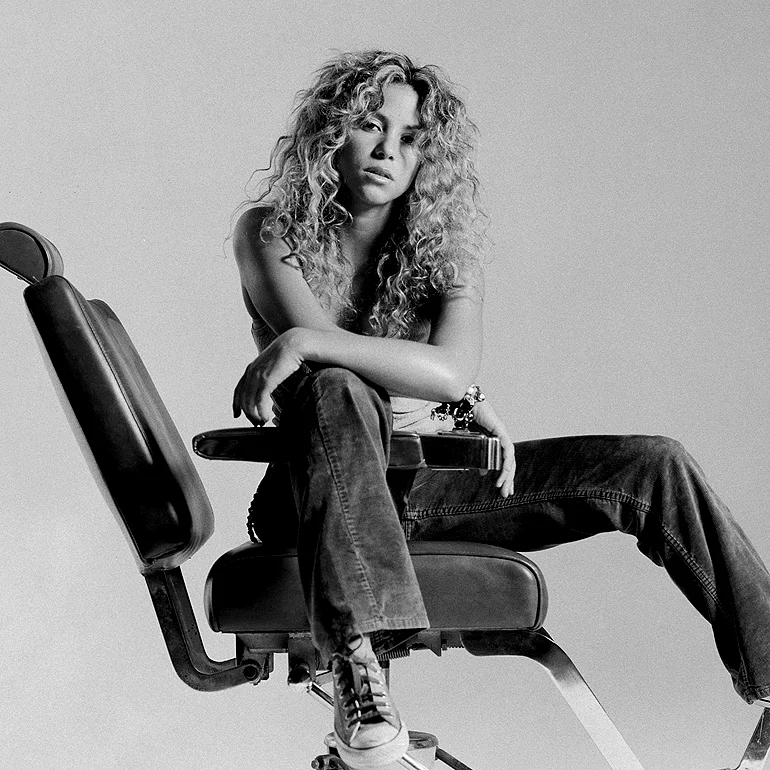
Internationally, the second major hit comes from “Beautiful Liar,” the collaboration with Shakira. This pairing reflects the 2006 moment clearly: Latin and cross-cultural collaborations were ascendant globally, and Beyoncé’s alignment with Shakira positions her within a transnational pop framework that stretched beyond American R&B’s shrinking space. The song’s success also reflects Beyoncé’s adaptability to global markets, even as she remains stylistically rooted in her own traditions.
Another element emerges within the album that marks a shift in Beyoncé’s public identity: her early engagement with the language of wealth and luxury. On “Upgrade U,” she lists markers of affluence (watches, briefcases, accessories) not symbolically, but with a fluency that positions Black access to capital as an ordinary part of adulthood. This moment predates the more explicit critiques of Black capitalism that would later surface in conversations about her and Jay-Z. Here, wealth enters the frame as a natural extension of the work-centric worldview she embodies: success validated through tangible signs. For Beyoncé’s elite Gen-X upbringing, shaped by the belief that labour could mitigate structural limitation, wealth was not merely aspiration; it was security and proof that work had produced stability. The line between protection and consumption becomes porous.
Another shift occurs in the public life of the couple. Jay-Z appears on several tracks, and his own transformation during this period matters. He has moved from being a successful rapper to an executive, a figure associated with maturation, responsibility, and upward mobility. The socio-cultural reading of him changes accordingly. Within B’Day, the couple’s image solidifies into a Black power partnership that departs from the archetypes previously available. Beyoncé’s image does not adapt to Jay-Z’s; his adapts to hers. Together, they embody a form of aspiration for the Black elite and a model of exemplarity for the Black middle class: a power couple whose trajectory seems reachable through discipline, stability, and work. The idea resembles the aspirational logic of 1990s Black sitcoms, where representation offered a blueprint for upward mobility and collective possibility.
The creation of B’Day itself reflects the generational logic that structured Beyoncé’s upbringing. She completed the standard version of the album in a matter of weeks, which is possible only for someone trained to work quickly, intensely, and without visible disruption. The speed reflects not only her discipline but also the industry expectation for frequent output. At the time, major artists were expected to release albums every two years; Beyoncé had taken three. The pressure to deliver a project that could stabilise her place in an evolving market was real. Her ability to produce at this pace becomes part of the album’s narrative: labour as identity, labour as reassurance, labour as the infrastructure of excellence.
The Beyoncé Experience tour develops another dimension of her politics. She surrounds herself with an all-women band, a decision that carries weight in an industry where musicians, especially those in supporting roles, are overwhelmingly men. Beyoncé practices gender politics structurally, not rhetorically. The choice signals that the success generated by Black women’s labour can be redistributed within a network of other women. It is one of the earliest examples of her using her position to reshape the conditions of performance around her, long before she articulated feminist positions explicitly.
Taken together, B’Day reflects a moment in which Beyoncé is navigating a shrinking cultural space while maintaining the lane she carved for herself. She expands her reach through sound, image, productivity, and relational positioning, yet remains tied to the belief that excellence (accelerated, efficient, unmistakable) can secure her place. The album holds the tension between a market moving away from her genre and a generational worldview that treats work as the central tool of survival. If Dangerously in Love was the presentation, B’Day is the acceleration: the moment when readiness becomes activity, and activity becomes the condition for staying visible.
I Am…Sasha Fierce – The Adjustment
By 2008, the musical landscape Beyoncé had occupied since her debut had undergone a noticeable contraction. R&B, once central to American radio, no longer held the same position. The genre that had defined the early 2000s lost institutional support within a few years, and the transition was abrupt enough to reshape the trajectory of artists who had relied on it. Hip-hop remained dominant, yet the lane Beyoncé had established for herself was no longer sustainable in a market where radio was still the primary means through which audiences discovered new music. The shift did not concern the audience’s interest as much as the structural narrowing of what was considered commercially viable.
In this context, I Am… Sasha Fierce emerges as a strategic recalibration. The dual-disc format reflects this moment clearly. Beyoncé divides the album into two sonic territories, each corresponding to a different space in the contemporary musical landscape. On one side, the “I Am…” disc relies on ballads and adult contemporary structures: pop inflected with R&B but shaped for formats that still welcomed a certain kind of emotional vocal performance. This is not a turn toward electro-pop, which was beginning to dominate the charts, but a turn toward a space where R&B-rooted voices traditionally maintained visibility. The adult contemporary lanes of the 1990s created a precedent for such positioning, and Beyoncé adapts this precedent to a late-2000s context.
The album is also her least politically anchored work to date. The pursuit of universality narrows the space available for political expression, especially for a Black woman whose visibility already carries racialised readings. The album is structured to minimise friction. Universality becomes the path to maintaining relevance and reach. Beyoncé appears racially neutral during this era, a neutrality some would attribute to colourism and others to the perfection of her presentation. In either case, her presence in white-dominated spaces becomes uncontroversial, a rare position for a Black woman in mainstream pop at the time.
The strategy is partially effective. Songs such as “If I Were a Boy” and “Halo” perform well and find the broad appeal that more rhythmic R&B was no longer afforded. These songs rely on a pop structure that leaves less room for the improvisational R&B vocal grammar Beyoncé had used previously. They carry fewer melodic deviations, fewer ornamental runs, and fewer spontaneous shifts. Instead, they prioritise melodic clarity and lyrical universality. This is the kind of pop balladry that travels easily across demographics and geographies, and that offers the listener a simplified emotional entry point. The economic crisis of 2008 also plays a role here. Audiences turned toward music that offered either escape on the dancefloor or stability through familiar structures. Beyoncé’s ballads place her in the latter category: reassuring, steady, and recognisable.
The second disc, “Sasha Fierce,” moves in a different direction. Here, Beyoncé remains connected to the Black musical influences that had defined her earlier work. Songs such as “Single Ladies,” “Diva,” and “Video Phone” draw from bounce, hip-hop, and rhythmic experimentation. The production aligns with a distinctly Black sonic vocabulary, even as the global market moves toward highly synthesised pop. “Sweet Dreams” and “Radio,” however, indicate a willingness to experiment with the dance-pop textures that would later define part of her output. Sasha Fierce functions as the branch through which Beyoncé can explore sounds that exist outside her previous palette without fully committing to the electro-pop trend that dominated the late 2000s.
This is also Beyoncé’s first album without any featured artists. Jay-Z’s absence is notable, especially given his presence in her earlier work. Presenting herself alone reflects both a new level of independence and a shift in her relationship to genre. Removing rappers from a project that leans toward adult contemporary and pop avoids any assumption that she remains anchored in hip-hop. It also reinforces her status as a singular entity capable of carrying an album without the support of an established partner. The success of “Irreplaceable” had already proven that she could dominate charts independently. The absence of features on this album is a natural extension of that success.
Single Ladies provides another shift in her public image. The video presents Beyoncé as a performer first. Its minimalistic background and emphasis on choreography recall the aesthetics of 1960s Black performers, where the artist’s body and movement provided the spectacle rather than visual embellishment. The song took two months to reach number one, and its success confirmed a new aspect of her identity. Beyoncé becomes a performer in the cultural imagination, not just a singer. The choreography becomes part of her signature, helping define her place in music at a time when dance was becoming an increasingly central component of pop stardom.
This period also includes the I Am… Tour, a year-long tour that reinforces her status as a performer with global reach. The tour operates as an extension of her work ethic, showing the scale at which her performance practice can function. It is through this tour that Beyoncé refines the structure that would later define her live work: precision, control, and a sustained level of intensity that aligns with the generational worldview in which she was raised. The tour becomes another space in which she stabilises her position during a volatile musical period.
The ballad side of the album sustains another aspect of her appeal. “If I Were a Boy” and “Halo” demonstrate that Beyoncé remains capable of carrying ballads that leave little room for improvisation but require control and emotional clarity. R&B artists often maintain an acute attention to vocal precision, and Beyoncé uses that discipline to succeed within pop’s ballad expectations. If B’Day relied on heavy percussion and rhythmic command, I Am… Sasha Fierce relies on the structure established by “Irreplaceable,” the mid-tempo sound that proved popular across demographics. The promotional strategy reflects this. When an “I Am…” single was released, a “Sasha Fierce” single followed. This dual release pattern allowed Beyoncé to maintain both audiences: those drawn to ballads and those drawn to performance.
Another element of this era is the recurring use of black and white in the visual rollout. At a moment when pop aesthetics were leaning toward maximalism, digital saturation, and high-colour spectacle, Beyoncé chooses a visual language that detaches her from the trends of the late 2000s. The absence of colour produces a different effect: it frames her as universal rather than contemporary, refined rather than tied to any specific subculture, and closer to a lineage of “classic” performers whose images circulated before the era of digital excess. Black and white also neutralises the visual codes through which Black women are often read. It softens the possibility of racialised projection and situates her inside a space where performance is the focal point rather than context. This decision aligns with the album’s broader logic of universality. The visuals protect her from the instability of the moment by presenting her as outside of it, which is another way of stabilising the image of someone who was expected to appeal across multiple audiences simultaneously.
Taken together, I Am… Sasha Fierce reflects a moment in which Beyoncé recalibrates her sound and image to remain viable within a shifting industry. She adopts a universal pop sound to maintain broad appeal and uses Sasha Fierce to preserve her connection to Black musical traditions and performance culture. The album holds the tension between visibility and universality, autonomy and expectation, Black influence and mainstream palatability. If B’Day relied on intensity, I Am… Sasha Fierce relies on adaptation. It is the period in which Beyoncé adjusts rather than expands, holding her place until the conditions allow her to redefine herself entirely.
4 – The Refusal
By 2011, the musical landscape Beyoncé had entered a decade earlier had disappeared almost entirely. Electropop dominated American radio at a level that left little room for anything else. The shift was not partial or transitional. It was almost absolute. Artists across genres were pushed into the electronic lane with uneven results, and rhythmic R&B lost the structures that once supported its visibility. Beyoncé’s own lane, shaped through live instrumentation, percussive arrangements, and an R&B-rooted vocal grammar, had no remaining presence on the radio. The erasure was systemic. In an era when radio airplay still determined a song’s longevity, the space that had allowed her emergence no longer existed.
This context explains the unusual position of 4. The album appears at a moment when the industry rewarded singles that resembled the electropop trend but was unable to convert those singles into stable album sales. Jennifer Lopez’s Love? exemplified this dynamic: “On the Floor” became a global hit, but the album struggled to find an audience. Electropop encouraged consumption of isolated tracks rather than full-length projects. This logic did not align with Beyoncé’s artistic identity. She had been trained to conceive albums as complete bodies of work rather than as collections of potential singles. Releasing a generic electropop project might have secured a hit, but it would not have sustained the type of career she had built.
“Run the World (Girls)” illustrates this tension clearly. As the lead single, it created a complicated narrative. Commercially, it peaked at number 28 and did not perform as expected for a Beyoncé launch. The sound was rooted in heavy percussion and brought an Afro-Caribbean sensibility to a market that no longer rewarded that vocabulary. The single was not aligned with contemporary radio demands, which favoured electronic textures and repetitive synth hooks. Yet the song held cultural weight beyond its chart position. It became an early sign of the feminist stance Beyoncé would adopt more openly in later years. The choreography, the staging, and the visual language surrounding the song were far more influential than its radio reception. “Run the World” failed to function as a commercial single, but it succeeded as an image. It signalled a shift in where Beyoncé’s cultural power would reside.
The second single, “Best Thing I Never Had,” followed a more familiar structure but faced similar challenges. It aligned more closely with the mid-tempo balladry that had supported her previous projects, but the environment did not reward such sounds. Neither rhythmic R&B nor traditional pop ballads were positioned for radio success in 2011. The issue was not the songs themselves. The issue was the musical moment. Beyoncé was releasing music that no longer had a broadcast home, and the singles reflected this mismatch.
The album, however, is deeply rooted in R&B at a moment when R&B had been rendered commercially non-viable. Beyoncé chooses not to follow the trend. She leans further into the lineage that shaped her: funk, soul, mid-tempo R&B, and 1980s melodic structures. The decision is deliberate. It is not nostalgic but grounded. The sound of 4 is self-contained, disconnected from the dominant currents of its time. Beyoncé presents an alternative to the electropop cycle without attempting to compete with it. The album becomes a statement of continuity when the industry had moved toward homogeneity.
This shift in strategy appears clearly in the way 4 is promoted. Instead of relying on singles to carry the album through radio, Beyoncé releases a series of videos for the project: “Countdown,” “Love On Top,” “End of Time” (with its Live at Roseland video), “Party,” “I Was Here,” and “1+1.” The intention is to sell the album as a whole rather than through one dominant track. Beyoncé adapts the promotional logic to reflect the reality that radio rotation can no longer support her. The emphasis on visuals, sequencing, and coherence anticipates the structure she would adopt for her subsequent projects. 4 marks the beginning of a shift in which Beyoncé’s work is consumed through video, staging, and conceptual framing rather than traditional radio performance.
The strategy proves effective. 4 sells more than four million units in the United States and reaches number one on the Billboard charts. The album’s commercial achievement is notable precisely because it is detached from the hit-making cycle of its time. Beyoncé becomes one of the few artists capable of selling albums during a period in which the industry was oriented almost exclusively toward singles. Her ability to do so reflects the strength of her audience but also the identity she had built throughout the 2000s. Beyoncé’s presence is no longer dependent on radio. She has become independent of the mechanisms that once supported her. In a lane that had been erased, she remains visible.
This is also the first album released through Parkwood Entertainment in partnership with Columbia. The significance of this shift is structural. Parkwood offers Beyoncé greater control over the shape of her work, the timing of releases, and the promotional strategies she could employ. The freedom to release multiple videos, the decision to lead with “Run the World,” and the overall tone of the project are enabled by this new arrangement. 4 becomes the first step toward her later autonomy. It signals a transition from artist to institution.
The visuals attached to the project contribute to this shift. The album artwork presents Beyoncé through an editorial lens, aligned with fashion photography rather than pop iconography. The imagery targets an adult audience. It is neither universal nor youth-oriented. The persona she presents is grown, composed, and grounded in a confidence that does not seek mass appeal. This is also the first time Beyoncé swears on one of her own albums. It is a small moment, yet meaningful. It disrupts the pristine image of the perfect Black woman, the one who upholds the demands of respectability at all times. The shift is subtle but signals a weakening of the narrative that had shaped her public identity in the early years of her career. The politics of respectability begin to recede.
The sequencing of the album reinforces this sense of reorientation. Beyoncé opens with ballads and places uptempos at the end. “Run the World” functions almost as a bonus track rather than the foundation of the project. This reverse order rejects the expectation that albums should lead with their most radio-friendly material. Beyoncé organises the project according to her own logic rather than the commercial one.
The era is also marked by performances that extend her reach beyond conventional album promotion. The digital background staging of “Run the World” becomes a visual template for later performances, including the 2013 Super Bowl. Live at Roseland positions Beyoncé as a performer first, grounding the project in live vocal work and in the intimacy of performance rather than the spectacle associated with electropop. She headlines Glastonbury, becoming the first woman to do so in more than twenty years. This moment is emblematic. As a Black woman in an industry that had erased her sonic lane, she continues to expand her status through performance rather than charts. She also announces her pregnancy during a performance of “Love On Top,” marking a personal milestone that becomes part of the public narrative of the era.
Taken together, 4 reflects a moment of displacement. Beyoncé’s lane no longer exists, yet she refuses to enter the one that replaced it. Instead, she constructs a framework in which album sales, visuals, and live performance create a stable position outside the conventional structures of the time. If I Am… Sasha Fierce was the adjustment, 4 is the refusal. It is the moment Beyoncé chooses continuity over trends and identity over universality. The album holds the tension between commercial expectations and artistic conviction, and it becomes the foundation for the autonomy that would define her next decade of work.
Beyoncé – The Liberation
By 2013, the music industry was entering a period of transition. The EDM wave that had dominated the early 2010s was beginning to fade, replaced not by a single dominant trend but by several lanes that coexisted without defining a unified mainstream. Artists who had relied on electropop were already adjusting toward a more universal pop sound, one that was less maximalist and more flexible. The structures that had organised the previous decade were dissolving. Television had lost its prescriptive power long before, but a new shift was emerging. Radio, once the definitive measure of impact, was beginning to follow rather than lead. Viral songs such as PSY’s “Gangnam Style” demonstrated that discovery no longer flowed from radio to the audience but from the audience to radio. The industry’s hierarchy of influence weakened, and with it, the conventional logic of releasing music.
The typical album rollout was also losing coherence. Every model had been attempted, from minimalist digital drops to maximalist months-long campaigns, yet none seemed to restore stability. The album as a concept was fragile at the end of the iTunes era. Consumers purchased individual songs, and cohesive projects became rare. The rhythm of album releases accelerated. Artists were expected to remain present by releasing projects within eighteen months, and Rihanna’s consistent output had become a benchmark. Only a few artists were able to resist this pace. Adele’s 21 offered a counterexample, a project that grew steadily over two years, but such cases were exceptional rather than representative.
Beyoncé had long encountered difficulties with traditional lead single strategies. “Run the World (Girls)” had been the most recent example of a lead single that failed to represent the scale of the project it introduced. By 2013, the team around her recognised that the lead-single-then-album model no longer served her work. The logic behind the late promotion of 4 becomes central here. For the self-titled project, they reversed the structure entirely. Instead of presenting a song in advance and asking the audience to anticipate the album, they released the project as a whole without announcement. The album was not a collection of potential singles but a complete object. The rollout was replaced by the work itself.
Beyoncé appears as a visual album with music videos for every track. This format redefines how the audience engages with music. Listening becomes inseparable from viewing. The album arrives fully realised, without intermediaries. At the moment of release, two songs were guided toward distinct audiences: “Drunk in Love” for hip-hop and rhythmic formats, and “XO” if adult contemporary radio was prepared to support a softer, more melodic single. This dual strategy reflects Beyoncé’s previous eras but operates differently. It is not a negotiation between two personas, as in I Am… Sasha Fierce, but a recognition that the album could address multiple publics without relying on a unified radio identity.
The sound of the album extends the work Beyoncé began on 4 but moves in several new directions. Songs such as “Drunk in Love” and “Flawless” deepen her engagement with hip-hop, yet the album is more varied than her previous output. She experiments with alternative textures, with disco-influenced pop, and with intimate ballads that feel closer to diary entries than to the universal statements of her earlier love songs. The album does not attempt to follow radio trends. Instead, it constructs a sonic environment around her voice, shifting between minimalism and fullness depending on the emotional space the song occupies.
The liberation of the album emerges most clearly in the lyrics. Beyoncé becomes more direct in expressing desire, and she allows sensuality to appear without the buffers she once maintained. The French monologue in “Partition” is explicit, not innuendo-based, and speaks to a sexual autonomy that she had not foregrounded before. This openness breaks with the respectability frameworks that had shaped her image for more than a decade. It destabilises the pristine ideal of the perfect Black woman who must present herself as composed at all times. Beyoncé does not abandon refinement, but she widens its boundaries. She allows the private to be visible in a controlled, intentional way.
The album also marks a turn toward explicit political content. In “Flawless,” she interpolates Chimamanda Ngozi Adichie’s speech on feminism, placing the word “feminist” at the centre of the track. The decision is not decorative. It emerges at the same time Beyoncé wrote an article arguing that gender equality remains a myth. The album’s release and the article reinforce each other. They signal a willingness to articulate political stances publicly, not only through implication or embodiment. Beyoncé moves from exemplarity to declaration.
This is the first time her personal life re-enters her work after years of distance. Jay-Z’s presence on the album underscores this shift. Their relationship becomes visible again. The intimacy here is real rather than symbolic. It disrupts the image of Beyoncé as someone whose personal life remains entirely separate from her art.
Motherhood also becomes part of the narrative of the album. Beyoncé reflects on its difficulty, its beauty, and its destabilising emotional landscape.
The album’s relationship to respectability politics evolves accordingly. Beyoncé shatters the image of the always-controlled, always-perfect woman without relinquishing her standards. She remains respected, but she decides the terms of that respect. The relatability of the album emerges through its intimacy. The songs feel personal not because they reveal secrets but because they express emotional realities. The distance between Beyoncé and her audience narrows. The perfection of the earlier albums created admiration; the vulnerability of this one creates recognition.
The release of Beyoncé changes the structure of the industry, but it also marks a turning point in her relationship to her work. This is the album where she self-centres fully. She creates a landscape in which her work can exist without negotiation. The liberation in this album is not only thematic; it is structural. Beyoncé frees herself from the cycle of singles and rollouts, from the demands of neutrality, and from the boundaries of respectability. The album becomes the foundation for the artistic autonomy she would expand in Lemonade and refine in Renaissance.
Lemonade – The Catharsis
Lemonade presents itself as both an album and a film. It is not simply a collection of songs; it is a body of work that speaks directly to the history of Black women in the United States. The film incorporates texts from Warsan Shire, whose poetry expands the emotional and cultural frame of the work. Through Shire’s words, Beyoncé connects Black womanhood in America to Black womanhood elsewhere, creating a bridge that situates her narrative within a wider diasporic context. The emphasis is not on personal confession, but on collective experience.
Visually, the project leans heavily on the American South. This is more than an aesthetic choice. The South is Beyoncé’s cultural background, but it is also the site where the history of Black womanhood is most deeply rooted and most visibly contested. The houses, the landscapes, the bodies of water, and the domestic interiors all anchor the film in a region where Black life has been defined by simultaneous violence and resilience. By grounding the visuals in the South, Beyoncé positions the work within a lineage rather than an individual story. She presents herself as part of a continuum rather than an isolated figure.
The narrative of Lemonade follows a progression from intuition to hurt, from anger to reconciliation. The structure is deliberate. It mirrors the emotional trajectory of a woman who realises something is wrong, confronts the truth, reaches a point of rupture, and eventually moves toward forgiveness. This trajectory is not limited to her marital experience. It becomes a metaphor for the place of Black women in America. Beyoncé cites Malcolm X in the film, reminding the audience that the Black woman has historically been the most disrespected person in the country. Yet she also presents Black women as the cultural backbone of American life. The film’s emotional structure therefore moves from the personal to the universal, and from the universal back to the personal. Black womanhood becomes the anchor, not the side note. The themes of emotional labour appear throughout the work. The labour of carrying family, of absorbing pain, of maintaining structures, of holding communities together. The album speaks to Black women first and to marginalised audiences second, but its emotional clarity makes it legible to many. The universality of the project does not come from neutralising Black experience but from presenting it with enough detail that it becomes recognised as foundational rather than peripheral.
The project closes with “Formation,” which had been released earlier in the year. A second surprise drop would not have produced the same impact. “Formation” stands apart from the narrative of the album yet reinforces its political stance. Musically, it leans heavily toward hip-hop. Beyoncé adopts a delivery that is more rhythmic and more direct, and the song becomes a declaration rather than a continuation. “Formation” is one of the most political songs of her career, addressing Black identity in the United States through references to regional culture, beauty standards, and resilience in the face of systemic violence. Its placement at the end of the album disrupts the emotional arc and introduces a new register: affirmation. The song acts as the final statement of the work, closing the personal narrative with a collective one.
Lemonade is Beyoncé’s first project that is unapologetically Black in its stance. The work is meant to speak to Black audiences first and foremost. It appears at a moment when the United States is fracturing along racial lines, and when the country is grappling with questions of violence, legitimacy, and systemic inequality. The project does not soften these tensions. It acknowledges the political moment without foregrounding it explicitly. The presence of Black women, the styling choices, the religious imagery, and the references to Southern culture all contribute to a work that is situated firmly within the politics of the time.
This period is accompanied by a performance at the Super Bowl, during which Beyoncé appears in an outfit referencing the Black Panther Party. The performance sits within ongoing political discussions about race and state violence. It widens the conversation initiated by “Formation” and confirms the album’s political orientation. Beyoncé is no longer adjusting her image to fit a universal frame. She claims a position that reflects the cultural reality she inhabits.
The album also addresses womanhood, particularly Black womanhood in the United States. It is concerned with the complexities of being a woman in a society that expects perpetual strength from Black women while dismissing their emotional needs. The work articulates a form of catharsis, where the expression of hurt, anger, and disappointment becomes a way to dismantle the expectation of silence. Beyoncé does not present herself as perfect. She does not maintain the pristine image associated with respectability. Instead, she breaks the image deliberately. The rupture is intentional, and it becomes the foundation for a new model of public identity.
The album also functions as a communication intervention. At the time, there were rumours surrounding her husband’s infidelity. Beyoncé chooses to address the subject on her own terms. She controls the narrative rather than letting it unfold through speculation. What could have been a public relations crisis becomes a moment of artistic clarity. The decision to divulge the experience through a full-length film and album creates distance between the rumour and the art while also using the rumour as a point of entry into broader discussions. The personal becomes structural.
Musically, the album feels timeless. The songs borrow from several genres: art pop, rock, R&B, soul, and even country. The variety is not eclecticism for its own sake. Each genre is used to support the emotional phase it accompanies. The cohesion comes not from sonic unity but from thematic continuity. The texts are written as a series of mantras, each reflecting a stage of emotional evolution. “Formation” remains the most detached from the narrative, functioning almost like a bonus track, yet it is the lead single, a choice that recalls the placement of “Run the World.” The decision makes sense only within the logic of Beyoncé’s communication strategy, which prioritises impact over chronology.
Most songs on the album are not radio-friendly. They are not designed to function as singles. They exist within the narrative architecture of the film and rely on that structure for their full meaning. The visuals reinforce this. The imagery throughout the film engages with spirituality, ritual, ancestry, and intimacy. The film includes references to water as purification, to domestic spaces as sites of memory, and to land as inheritance. These visuals connect the emotional narrative to a broader historical one. The work also addresses police violence. The video for “Formation” includes images that speak to state violence and to the precariousness of Black life in the United States.
Taken together, Lemonade becomes a form of catharsis. It articulates emotional truth, collective memory, and political stance within a single framework. Beyoncé moves away from the idea that perfection provides safety. She embraces vulnerability as a form of strength and situates herself within a tradition of Black women whose stories carry both pain and resilience. If the previous albums navigated the tension between universality and specificity, Lemonade resolves it. Beyoncé presents Black womanhood as central, complex, and complete. The catharsis comes not only from expressing pain but from recognising it as part of a larger historical narrative. It is the moment in which Beyoncé stops adapting to the structures around her and begins shaping the cultural space in which she exists.
Renaissance – The Liberation of Others
By 2022, the musical landscape had shifted in ways that bore little resemblance to the structures that shaped Beyoncé’s earlier work. Streaming had become the dominant mode of listening, restructuring the industry around visibility rather than genre. Yet despite the accessibility streaming offered, urban music had been pushed to the margins of the year’s biggest hits. R&B existed primarily in niche spaces online, sustained by artists such as Frank Ocean and Jhené Aiko who had revitalised the genre a decade earlier through alternative and internet-based communities. Hip-hop still generated hits, but its cultural centrality was weakening. The songs released by artists like Taylor Swift or Harry Styles defined the cultural moment more clearly than the work of many rappers, even as hip-hop maintained numerical dominance on streaming platforms.
The early 2020s rewarded artists with recognisable identities, particularly those who had maintained consistent visibility for more than a decade. Drake, Taylor Swift, and Beyoncé belonged to this category. They were already familiar to listeners whose habits had become fragmented. Their longevity made them legible in a landscape shaped by constant shifts and rapid consumption cycles. In this environment, stability became a form of cultural currency. Beyoncé’s presence was therefore not only artistic but structural: she remained visible in a space where genres had dissolved and recognition was no longer guaranteed.
On Renaissance, Beyoncé does not centre herself. Instead, she centres Black queer culture, particularly the traditions that emerged in queer Black spaces over the past five decades. The album exists as a stance. It asserts that Black liberation cannot exclude queer people, and that the cultural history of Black queer communities is foundational to the music that has shaped global pop. Beyoncé includes drag performers and queer artists throughout the project, not as symbolic gestures but as participants in the world she constructs. Their presence transforms the album from a dance project into a political one, not through explicit messaging but through the act of recognition.
There had been hints of queer visibility in Beyoncé’s earlier work. The ballroom-inspired choreography and queer male dancers in the “Get Me Bodied” video, and the references to gay marriage in the visual language of “7/11,” showed that queer communities existed around her work. However, she had not taken a clear stance on the place of queer people in the cultural and political landscape of the United States. Renaissance offers that stance without stating it directly. Beyoncé adopts the vocabulary of ballroom culture, the rhythmic and textual markers of house music, and the sensibilities of queer nightlife. By doing so, she positions herself within a lineage she had not previously claimed so explicitly. She borrows the language of a counterculture and amplifies it on a global scale. The gesture is political because it recognises a community that has often been present yet unacknowledged in the mainstream.
One of the distinguishing features of Renaissance is its absence of visuals at release. This is unusual for Beyoncé, whose previous projects relied heavily on visual language. The album exists primarily as sound, accompanied only by the artwork that presents her on a silver horse designed as a disco ball. The image is symbolic rather than explanatory. Beyoncé appears as part of the aesthetic vocabulary of disco, aligning herself with a form defined historically by Black and queer artists. The absence of a full visual component places the album’s emphasis on sound, structure, and reference rather than narrative. It also reflects a different mode of engagement. Beyoncé is not presenting a story but a space.
Musically, Renaissance remains a Beyoncé album while interpolating disco and house sounds that have been present in Black queer culture for decades. The inclusion of Grace Jones on “Move” reinforces this alignment. Grace Jones is not only an icon but a figure whose career intersects directly with queer nightlife, fashion, and performance. Her presence is a signal of the lineage Beyoncé is acknowledging. The album shifts across subgenres without losing coherence because the throughline is community. Each sound belongs to the same cultural archive.
The album establishes dance and pleasure as forms of liberation. The lyrics frequently appear light, yet the insistence on joy carries weight. “Break My Soul,” the lead single, functions as a mantra of resilience. Beyoncé repeats “You won’t break my soul” as a statement of endurance, addressing not only personal resilience but collective survival. The dancefloor is presented as a space where fragmentation can be suspended. It is a space of self-preservation for marginalised communities, and the album builds itself around that logic. The music does not attempt to escape reality but to create a place where reality becomes bearable.
Structurally, the album functions like a DJ set. Songs blend into one another, with transitions that shift beats and maintain continuity. This cohesiveness replicates the experience of queer clubs, where the movement from one track to another sustains a communal rhythm. The fluid transitions reinforce the idea that the album is not a collection of songs but an environment. The underlying theme is confidence, resilience, and self-assurance, which connects the album to the lyrical concerns of Beyoncé’s previous work. Yet here, these themes are expressed within a collective space rather than an individual narrative.
After dismantling the idea of Black perfection in Lemonade, Beyoncé moves toward another form of liberation on Renaissance: the liberation of others. She encourages self-love within marginalised communities, not as a reaction to trauma but as a rightful condition. The album does not present struggle as the centre of experience. It presents joy as a form of resistance. Beyoncé’s voice becomes one among many, participating rather than leading. This shift is significant. She steps into the community she honours, rather than speaking on behalf of it.
Renaissance is therefore not only a celebration of queer Black culture but a recognition of its foundational role in shaping contemporary music. Beyoncé uses her platform to make visible the communities whose creativity has often been appropriated without acknowledgment. The album expands her liberation project beyond herself. It is not centred on her catharsis or her emotional landscape. It is centred on collective joy, historical continuity, and the affirmation of identities that have shaped the rhythms of modern culture. Beyoncé positions herself as part of this lineage, using her visibility to make room for those whose contributions have been erased.
Taken together, Renaissance becomes an act of cultural recognition. It constructs a world where marginalized identities are not peripheral but central. Beyoncé shifts from the personal to the communal, from self-liberation to the liberation of others. After breaking the ideal of perfection and reclaiming her narrative, she chooses to create space for the communities that shaped the cultural forms she embraces. The album presents joy as collective resistance and places Beyoncé within a tradition she acknowledges rather than invents. In doing so, she extends the trajectory of her career beyond individual artistry toward cultural stewardship.
Cowboy Carter – The Reclamation
By 2024, the structure of mainstream music consumption had changed almost entirely. Streaming platforms had become the primary space where hits were produced and sustained, and listeners were no longer tied to physical releases. Beyoncé adapted to this landscape with a restrained physical rollout, offering limited copies of the album on CD while favouring streaming as the main site of distribution. Vinyl remained available, but the commercial emphasis was digital. The shift reflected a broader transformation in listening habits, where the album’s presence on platforms mattered more than its physical circulation.
Country music had become one of the most stable forces within the American industry. Its audience was more inclined to listen within the genre’s bounds, and this consistency contributed to several country albums reaching the top of the Billboard charts. Country listeners engaged in traditional consumption patterns, supporting full albums rather than isolated tracks. This renewed visibility was occurring at a moment when nationalist discourse had grown more present in the United States. Genres considered white and American gained prominence in a political environment increasingly focused on heritage, identity, and belonging. Country music, shaped by these cultural pressures, appeared as a space reserved for a specific demographic, even though its origins were far more complex than its contemporary image suggested.
With Cowboy Carter, Beyoncé intervenes in this narrative. She reintroduces the Black origins of country music to a public that had largely forgotten them. The genre is anchored in the blues, a Black form that influenced every aspect of early American popular music. Beyoncé constructs a fictional radio throughout the album, presenting rising Black country artists alongside iconic figures such as Dolly Parton. The inclusion of Dolly Parton, an artist associated with the image of the intellectual blonde whose songwriting is both accessible and thoughtful, reflects a deliberate conversation between eras, aesthetics, and identities. Beyoncé situates new Black voices in the same frame as established legends, restoring a continuity that had been interrupted by decades of racial erasure.
The visual language of the album reinforces this reclamation. Beyoncé presents the Black cowboy as central to American iconography. Historically, Black cowboys were a visible part of the South and the West, yet they were removed from the narratives that shaped national memory. By reinstating the Black cowboy in her imagery, Beyoncé reminds audiences of their presence and their contributions. The American flag on the album cover functions as another layer of recontextualization. Patriotism is often framed as a white domain, yet Beyoncé depicts herself as part of the national fabric. She argues that the right to patriotism cannot be restricted to a single racial identity. The gesture may be read as nationalist, but it emerges from a place of historical correction. Beyoncé is not idealising the nation; she is asserting that Black Americans have shaped its culture as deeply as those who claim exclusive ownership of its symbols.
This intervention aligns with the nature of country music itself. Unlike pop, hip-hop, or electronic music, country has travelled less internationally. It remains a genre strongly tied to the United States. By entering this space as a Black woman, Beyoncé occupies a position rarely granted to artists outside its traditional demographic. The album acknowledges that country music is profoundly American, and Beyoncé’s participation asserts that Black voices belong within that identity. Her presence challenges the idea that American cultural forms are racially homogeneous and that whiteness defines authenticity within the genre.
Beyoncé had approached country music before. “Irreplaceable” carries a country-inflected structure, and “Daddy Lessons” explicitly enters the genre’s vocabulary. However, her performance with the Dixie Chicks made clear the limitations imposed on her. The response to that collaboration revealed that structural support within the country industry depended on conforming to expectations shaped by whiteness. Beyoncé did not receive that support. The barriers she encountered emphasised the boundaries of the genre and the resistance to recognising Black contributions.
In Cowboy Carter, she does not wait for the system to validate her. Instead, she constructs her own system. Without institutional support, she receives the Grammy Award for Album of the Year, underscoring the cultural weight of the project despite the absence of endorsement from the traditional country infrastructure. Beyoncé does not seek approval from those who excluded her. She reframes the genre so that it aligns with the history from which it emerged.
The album’s promotion further illustrates Beyoncé’s approach. As with previous eras, the Super Bowl becomes a central site of visibility. The advertisement that launched the Cowboy Carter era situates her as a figure capable of transforming promotional spaces into cultural events. The Super Bowl, a deeply American ritual, amplifies the project’s thematic concern with belonging and identity. Beyoncé’s presence there reinforces the legitimacy of her engagement with American musical tradition.
The tour accompanying the album follows the scale of the Renaissance World Tour. It reaches multiple continents and reinforces Beyoncé’s identity as a performer whose live work extends her studio practice. The Cowboy Carter tour integrates the visual and thematic elements of the album into a performance environment that celebrates the Black cowboy, the history of the South, and the multiplicity of American identity. Beyoncé performs as someone who occupies the stage confidently, not to assimilate into country music but to reframe it. Her presence becomes a statement about the space she claims and the history she represents.
Lyrically, the album addresses themes of belonging, resilience, and reclamation. Beyoncé speaks from the perspective of someone navigating spaces that were not built for her yet are part of her cultural inheritance. The album reinforces the idea that America’s musical traditions cannot be separated from the contributions of Black artists. Beyoncé does not narrate her life story. Instead, she narrates the displacement and re-entry of Black people within country music. She writes about freedom not as an abstract concept but as an assertion of identity within structures designed to exclude her.
Cowboy Carter functions as a reconstruction of cultural memory. Beyoncé presents an alternative version of country music’s lineage, one that restores the presence of those omitted by historical narratives. She uses the visibility she has accumulated over two decades to create a platform for artists often marginalised within the genre. The project extends the trajectory established in Renaissance, where she centred queer Black culture. Here, she centres Black American identity within a space that had been designated as white. Beyoncé is no longer adjusting, refusing, or liberating herself. She is reshaping the categories available to her and to those who will follow her.
Taken together, Cowboy Carter becomes a statement about identity, heritage, and cultural authorship. It addresses the tension between belonging and exclusion, reminding listeners that America is not defined by monolithic narratives but by the histories that coexist within it. Beyoncé reconstructs a genre by restoring the memory of those erased from it. She stages a cultural correction and claims the space that history denied. In this album, belonging is not requested. It is affirmed.
Across her career, Beyoncé becomes a figure who reveals the shifting possibilities and constraints of Black womanhood in American popular culture. Beyoncé moves from presenting herself as prepared and exemplary to presenting herself as vulnerable, political, and grounded in a lineage that precedes and exceeds her. She transforms from a participant in existing structures to an architect of cultural spaces in which others can locate themselves.
The early eras show the limits of the generational myth that excellence could guarantee safety. Beyoncé’s mastery could not prevent the collapse of her genre’s visibility nor the cultural shifts that narrowed the space available to Black women in mainstream pop. Yet rather than dissolving into trends, she refused to adjust herself to a landscape that no longer had room for her. She learned to create work that sustained itself without relying on radio, and to use visual and structural strategies to maintain autonomy. This refusal prepared the ground for the more explicit interventions that followed.
With the self-titled album and Lemonade, Beyoncé shifts from managing her image to managing her narrative. She speaks about desire, vulnerability, rupture, and survival through a vocabulary grounded in Black womanhood. The work becomes a site of catharsis, not only for herself but for the communities that recognise their experiences within it. In Renaissance, this catharsis extends outward and becomes a tribute to the queer Black traditions that shaped dance music. Beyoncé no longer uses her platform simply to express her own liberation, she uses it to make visible the cultures that sustained her.
Cowboy Carter brings the trajectory into another register. Here, Beyoncé enters a genre constructed as white and American and reclaims it as part of her lineage. She does not assimilate into country music, she restores the history that predates its institutional boundaries. The album marks a shift from personal liberation to cultural stewardship. Beyoncé becomes a narrator of memory, returning erased histories to the centre and affirming that belonging is not granted but inherited through ancestry and corrected through authorship.
Taken together, these albums reveal an artist who expands the terms of her own visibility. Beyoncé demonstrates that liberation is not a single moment but an accumulation of choices, ruptures, refusals, and reconstructions. Her work shows how a Black woman can move through structures designed without her in mind and gradually reshape them to reflect the histories they tried to forget. In doing so, she offers a model not of perfection but of transformation. Her career becomes a study in how identity, lineage, and authorship intersect to produce a cultural figure whose impact extends beyond music into the realm of collective memory.


 Elemental Emancipation
Laisser un commentaire