2007 marked a moment when major labels increasingly focused on maximizing profitability with already proven acts. There was less emphasis on novelty and more on consolidating artists who had demonstrated their ability to generate consistent returns. In this context, Rihanna’s rapid rise to becoming the label’s central female act proved decisive. Having already been tested through two successful projects, there was no longer a need to reposition her cautiously. Instead, the label could now fully invest in scaling her.
Around this time, following a relatively short promotional cycle for “A Girl Like Me”, Rihanna entered the phase that would define her public persona for years. Only two years after her debut, she was already preparing her third project, maintaining a release rhythm that was fast even by industry standards. This pace ensured continuous visibility, but more importantly, it shifted the strategy: rather than relying solely on album cycles like other artists, the focus moved toward a sustained stream of hit singles as the primary mechanism for maintaining relevance and ubiquity.
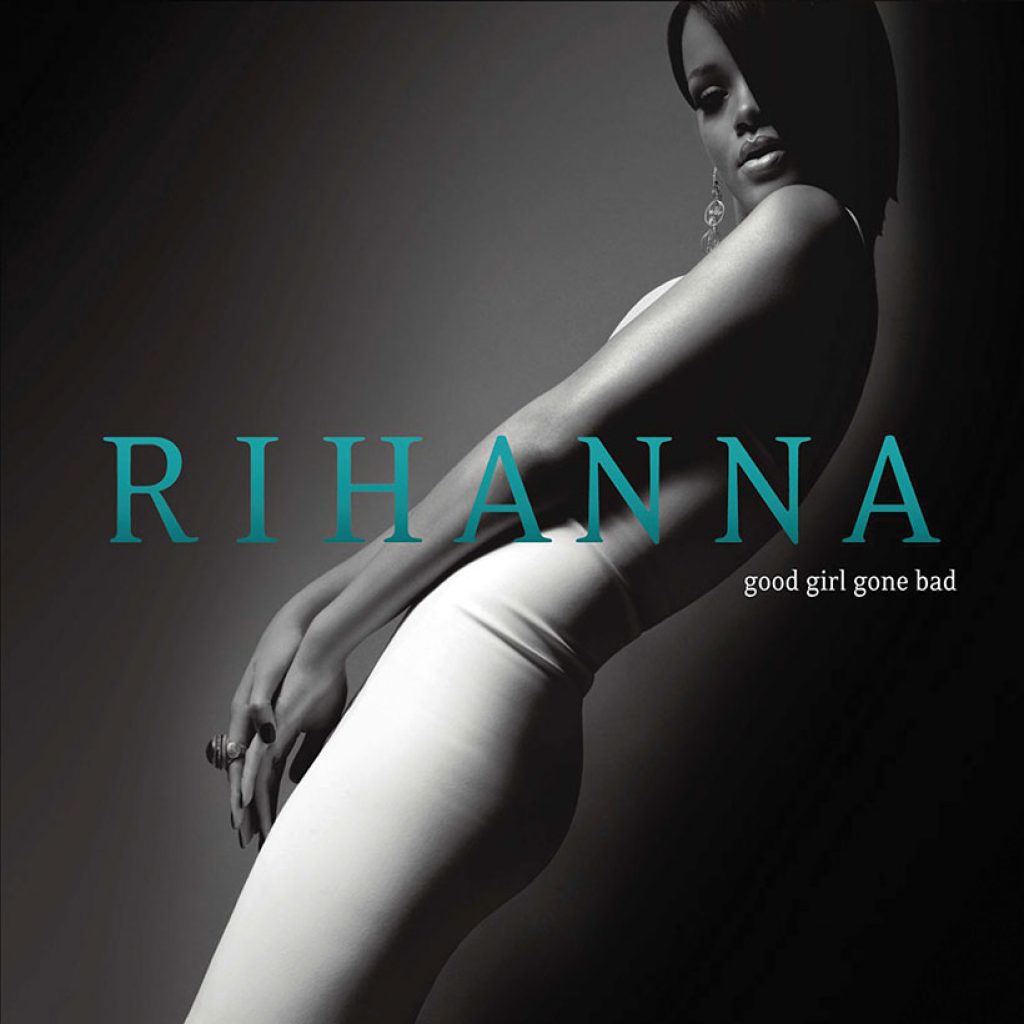
The strategy for “Good Girl Gone Bad” was therefore far more concentrated. The creative direction shifted away from Carl Sturken and Evan Rogers toward a select group of high-impact hitmakers such as Stargate, The-Dream, and Timbaland, alongside songwriters known for producing chart-dominating singles. The increased budget reflected a change in status: Rihanna was no longer a developing act but an asset worth building around. At the time, there was speculation that this strategic refocusing came at the expense of other artists on the roster.
The marketing positioning differed sharply from her previous efforts. Rihanna was no longer framed as a Caribbean-inflected newcomer but as the fully-fledged pop star. The objective was not to compete within “urban” categories but to secure a place at the centre of the global pop market, alongside artists such as Britney Spears. The release of “Umbrella,” with its graphic visual presentation, marked a decisive shift. The imagery was more editorial, more stylized, and more assertive, signalling her transition into a mainstream pop figure.
Sonically, the album minimizes Caribbean influences, which remain only marginally present on tracks like “Lemme Get That.” This shift is not incidental but strategic. While her earlier work benefited from a sense of “otherness,” particularly in European markets, “Good Girl Gone Bad” prioritizes global readability. The project is built around highly radiophonic pop structures designed for both mainstream and rhythmic radio. The ambition for each track to function as a potential single is reflected in the album’s construction: rather than a unified sonic identity, it offers a curated range of contemporary pop styles, held together by Rihanna’s increasingly commanding vocal delivery and recognizable stylistic inflections.
The album also builds on the insight that her audience was not confined to R&B or reggae listeners, but was engaging with pop in multiple forms. As a result, “Good Girl Gone Bad” operates as a catalogue of pop possibilities. It incorporates European and club-oriented sounds, as heard in “Push Up on Me” and “Don’t Stop the Music,” alongside pop-rock elements in “Shut Up & Drive.” Rather than committing to a single genre, the album assembles the dominant sonic trends of the mid-2000s into a flexible framework. Ballads are present but limited, and remain firmly within conventional, radio-friendly formats.
Lyrically, the album targets a young adult audience, moving beyond teenage simplicity while remaining broadly accessible. Themes range from flirtation to early emotional conflict, reflecting a transitional stage between adolescence and adulthood. “Question Existing” stands apart as a more introspective track, implicitly referencing the pressures of her rapidly ascending career. While much of the material continues to be written by external collaborators, the delivery begins to align more closely with a distinct persona.
Visually, this era marks the emergence of Rihanna as a fashion figure. From the leather aesthetics of “Umbrella” to the introduction of her asymmetrical black hairstyle, her image creates cultural influence. She begins to occupy the role of a fashion “it-girl,” balancing an edgy sensibility with mainstream appeal, and becoming a reference point for young women and teen audiences.
The rollout was extensive, spanning nearly two years and generating a remarkable number of singles. With over eight singles released and further extended through a reissue, the campaign maximized the album’s commercial lifespan. The re-edition introduced “Take a Bow,” a pop/R&B ballad, and “Disturbia,” a darker pop-dance track, crystallizing two key lanes that would define expectations around Rihanna: one oriented toward Anglo-American R&B sensibilities, and another toward European dance-pop markets.
This dual strategy was further reinforced through regionalised single choices, inspired in part by the rollout of Loose by Nelly Furtado. For instance, while “Shut Up & Drive” was prioritized in the United States, European markets emphasized “Don’t Stop the Music,” aligning with regional preferences for club-oriented sounds. Later in the rollout, these choices were effectively reversed, introducing each sonic approach to new audiences once Rihanna had already been established as a reliable hitmaker. While projects such as Blackout by Britney Spears contributed to the rise of EDM-inflected pop, Rihanna positioned herself as a central figure within the wave that would dominate the period from 2008 to 2012.
With “Good Girl Gone Bad”, Rihanna secured her position as a leading hitmaker. “Umbrella” became one of the defining songs of 2007, achieving widespread success across major markets. More importantly, the album’s strategy transformed what had previously appeared as a lack of fixed artistic identity into a structural advantage. By offering multiple, carefully calibrated versions of pop success, the project allowed her to appeal to different audiences simultaneously.
In this sense, the approach builds directly on the dual success of “SOS” and “Unfaithful,” but expands it into a full-scale system. What had once seemed like inconsistency becomes, here, a defining methodology: adaptability as identity, and multiplicity as a means of domination within the pop landscape.
Within this framework, Rihanna also occupies a significant representational space. At a time when few Black women were positioned at the centre of global pop following the relative absence of figures like Janet Jackson, she emerges as one of the first to fully reclaim that space in both Anglo-American and European markets. In doing so, she offers a form of visibility for audiences who were not accustomed to seeing themselves represented within predominantly white mainstream pop platforms.
Rihanna – Music of the Sun
Rihanna – A Girl Like Me
Rihanna – Good Girl Gone Bad
Rihanna – Rated R


Leave a Reply