Yours Truly – The Permission
When Ariana Grande released “Yours Truly” in September 2013, the transition from children’s television to popular music had become a familiar industrial ritual. Disney had developed an especially efficient version of this process, using television series, films, soundtracks, radio networks and record labels to convert young performers into recording acts without requiring audiences to encounter them as entirely new figures. Miley Cyrus, Selena Gomez and Demi Lovato had each benefited from this integrated structure, even when their eventual movement into adulthood required a more visible rejection of the identities through which they had first become famous.
Nickelodeon offered Ariana Grande considerable visibility through “Victorious” and “Sam & Cat”, but it did not possess an equally successful musical infrastructure. Recognition could guarantee attention, but it could not establish authority. Grande therefore entered the recording industry with an unusual combination of advantages and liabilities. She already had an audience, yet that audience knew her primarily as Cat Valentine, a character defined by exaggerated sweetness, comic naivety and a deliberately childlike voice. Her problem was not obscurity. It was conversion. Republic Records needed to transform an actress associated with children’s entertainment into a credible recording artist without alienating the young audience that made the investment attractive.
“Put Your Hearts Up”, released in 2011, demonstrated the limitations of the most obvious solution. Built around the melody of 4 Non Blondes’ “What’s Up?”, the song treated Grande as a conventional child-pop performer, surrounding her with bright colours, motivational language and a broad message of collective optimism. It attempted to extend her Nickelodeon identity into music rather than replace it. Grande would later distance herself from both the recording and its visual presentation, but the single remains important because it reveals the category she needed to escape. Its failure was not simply aesthetic. It showed that recognisability alone could not support the kind of career being imagined for her. The television persona provided exposure while simultaneously obscuring the musical ability that was meant to justify her presence beyond it.
“Yours Truly” corrects that problem without demanding a dramatic rupture. Grande does not announce adulthood through provocation, sexual rebellion or the destruction of her earlier image. Instead, the album moves backward. It uses the established authority of doo-wop, 1990s R&B and hip-hop soul to create a form of maturity that can coexist with sweetness. Where other former child performers had attempted to demonstrate adulthood by showing how much they had changed, Grande demonstrates seriousness by revealing a voice that appears to have existed beneath the television character all along.
This is the central permission constructed by “Yours Truly”. The album allows Grande to become musically adult while remaining socially adolescent. Its vocal arrangements, samples, collaborations and historical references place her inside traditions associated with technical discipline, emotional sophistication and romantic experience. Yet these sounds do not require her to surrender innocence. R&B performs adulthood on her behalf.
That distinction matters because popular music does not merely racialize sound. It racializes the timetable of maturity. Black girls have repeatedly been denied the protection of adolescence, especially when performing musical forms already coded as sensual, emotionally experienced or culturally adult. Their proximity to R&B can be used to presume knowledge, availability and maturity before they have been permitted to define those qualities for themselves. Grande encounters the opposite possibility. At twenty, she can draw authority from Black musical adulthood while continuing to be presented through the visual and emotional vocabulary of girlhood. Her voice is allowed to know more than her image does.
The album’s retro construction makes this separation possible. Its references do not belong to a single period because no stable adult identity has yet been created for Grande. Instead, “Yours Truly” assembles one from musical histories that already possess authority. The doo-wop elements supply courtship, innocence and romantic idealism. The 1990s R&B arrangements certify vocal ability and emotional seriousness. Hip-hop samples provide rhythmic recognition, while contemporary rap features connect the project to the existing market. Grande moves between these periods because historical citation can give her the signs of adulthood without requiring a fully developed adult persona.
“Tattooed Heart” makes this temporal protection explicit. Its desire to love as though it were 1954 places romance inside an imagined past, removed from the complications of contemporary sexual life. The year functions less as history than as atmosphere. It evokes permanence, courtship and emotional simplicity, allowing Grande to perform longing as something timeless rather than socially specific. The song’s restrained arrangement also concentrates attention on her voice, which rises from controlled intimacy into theatrical power. Grande sounds mature because of what she can do vocally, not because the song requires her to describe an adult world.
This relationship between voice and personality defines much of the album. “Yours Truly” does not yet establish Grande as a particularly revealing narrator. Its lyrics remain broad enough to preserve distance between the performer and the emotions she is asked to communicate. Longing, devotion, infatuation and heartbreak appear without much biographical or psychological specificity. The songs give her feelings to inhabit, but not a developed self to expose. She can sound emotionally experienced without making claims to experience that might unsettle the innocence surrounding her.
The voice is therefore more mature than the person the album permits audiences to know. It becomes the principal evidence of authenticity, carrying technical and emotional information that the lyrics themselves rarely provide. Grande is not yet being sold as an author whose interior life structures the record. She is being introduced as an exceptional instrument. “Yours Truly” proves vocal authenticity before it attempts personal authorship.
Babyface’s involvement is essential to that process. His work connects the album to an R&B institution in which songwriting, arrangement and vocal interpretation remain inseparable. Harmony Samuels provides another form of continuity, helping the album evoke the architecture of late-1980s and 1990s R&B without becoming a simple collection of reproductions. Their presence allows Grande’s engagement with the genre to be presented as apprenticeship. She appears to have studied a tradition under the supervision of people who participated in constructing it.
Her ability makes that account persuasive. Grande does not approach R&B as a temporary visual costume while relying upon conventional pop delivery. Her phrasing, harmonies, runs and layering demonstrate genuine technical investment. Yet sincerity does not remove the racial asymmetry surrounding the project. Institutional collaboration manages the question of appropriation rather than eliminating it. Black musical culture becomes a body of knowledge that Grande can prove herself qualified to inherit. Once she has demonstrated sufficient fluency, its codes are reclassified as evidence of universal musicianship.
The same codes did not produce the same freedom for Black female performers. For them, R&B could become a commercial boundary, limiting radio formats, promotional budgets and imagined audiences. For Grande, it becomes an opening argument. The genre establishes credibility without determining the limits of her future career. Her whiteness remains culturally unmarked enough to absorb Black sonic authority without being permanently assigned to the market category from which that authority was taken. She can be validated through R&B and subsequently released from it.
“The Way” turns this arrangement into a viable pop proposition. Its central sample reaches Brenda Russell through Big Pun’s “Still Not a Player”, placing Grande inside a chain of musical memory that had already travelled from soul into hip-hop. The production carries the familiarity of that history, but its brightness prevents the song from feeling weighed down by reverence. The result sounds youthful without becoming juvenile. Grande’s vocal performance establishes virtuosity, while the buoyancy of the recording keeps virtuosity from becoming formal or intimidating.
Mac Miller’s presence is equally functional. He connects the song to contemporary hip-hop while remaining compatible with the young, predominantly pop audience Grande had inherited from television. The collaboration allows hip-hop to signify proximity and ease rather than danger or rupture. Their flirtation is playful, and the song’s romantic language remains immediate without acquiring psychological weight. “The Way” does not demand that audiences decide whether Grande has become an adult. It allows them to enjoy the transition before recognising that one has occurred.
Its video preserves the same balance. Balloons, dancing, projected images and physical play create an atmosphere of spontaneity rather than spectacle. Grande is no longer enclosed within the visual precision of a television character, but neither is she presented through the conventional imagery of emancipation from child fame. There is no declaration that the old identity has been destroyed. The video replaces artificial innocence with apparently natural youthfulness. Its informality makes the transition look self-generated, even though the boundaries remain carefully controlled.
This is why “The Way” succeeds where “Put Your Hearts Up” had failed. The earlier single asked audiences to accept Grande as a children’s performer making children’s pop. “The Way” allows them to discover a singer. It resolves the Nickelodeon credibility problem, introduces R&B and hip-hop without producing an image crisis, and makes exceptional vocal ability accessible through flirtation and play. It does not reject Grande’s existing audience. It enlarges the cultural world around her until that audience is no longer what defines her.
The rest of “Yours Truly” sustains this process with varying degrees of coherence. “Baby I” reinforces her connection to exuberant 1990s R&B, while “Right There” reproduces the sample-driven logic of “The Way” with Big Sean occupying the contemporary rap position. “Almost Is Never Enough” places Grande within the prestige of the vocal ballad, presenting emotional restraint as another form of maturity. Elsewhere, the album’s attempts to accommodate contemporary production expose the instability of the construction. Yet this unevenness is not merely evidence of uncertain direction. It reflects the transitional work the album has been asked to perform. Grande does not yet possess a present-tense musical identity, so the record builds one from several authorised pasts.
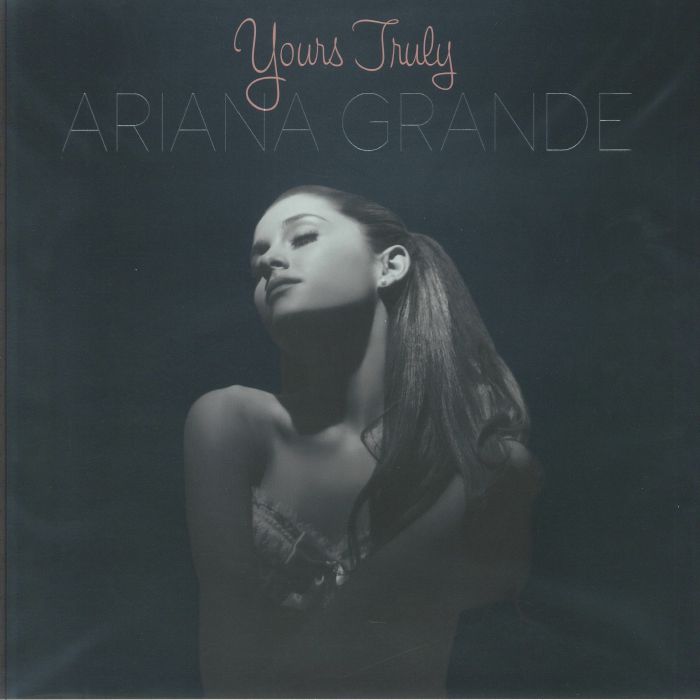
Her visual presentation similarly refuses a complete departure from girlhood. The styling is polished and feminine, but rarely confrontational. Pastel colours, floral dresses, bows and softly nostalgic imagery preserve continuity with the sweetness through which audiences first knew her. The album cover’s attempts at sophistication remain constrained by this protective language. Grande can be glamorous, but glamour is softened into delicacy. She is permitted proximity to adult femininity without being made responsible for all of its implications.
The industry’s recurring comparison with Mariah Carey condensed the album’s strategy into a single reference. The comparison was encouraged by range, whistle tones and melismatic phrasing, but it also provided an immediately recognisable vocabulary through which Grande’s voice could be understood. She arrived already attached to an established standard of female vocal excellence. The comparison risked diminishing the individuality of her instrument, yet it served an important institutional purpose. If Nickelodeon had made Grande appear manufactured, vocal resemblance to one of the most technically respected singers in popular music made her talent appear undeniable.
Commercial reception confirmed that the distinction could support more than a niche introduction. “The Way” reached the American top ten, while “Yours Truly” entered the album chart at number one. The surprise surrounding the record often depended upon the distance between the Cat Valentine persona and the voice now being foregrounded. Grande was received as though an extraordinary singer had been concealed inside a familiar television image. This apparent revelation allowed the industry to present her credibility as discovery rather than construction.
“Yours Truly” is therefore less a definitive artistic identity than a carefully designed passage. It gives Grande permission to escape children’s television without repudiating childhood, to approach adulthood without surrendering the protections of white femininity, and to use Black musical history as evidence of seriousness without being confined by the market categories attached to it. Its retro world allows her to sound older than her image while remaining younger than her voice.
That equilibrium could only be temporary. Once the album demonstrated that Grande’s voice, image and existing audience could travel across formats, Republic no longer needed to preserve the coherence of the apprenticeship. “My Everything” would dismantle the historical environment of the debut and distribute her across the widest possible range of contemporary genres, collaborators and radio markets. The permission secured by “Yours Truly” became the basis for expansion. Its achievement was not merely introducing Ariana Grande. It made a highly managed transfer of authority appear like the natural emergence of talent.
 Elemental Emancipation
Leave a comment