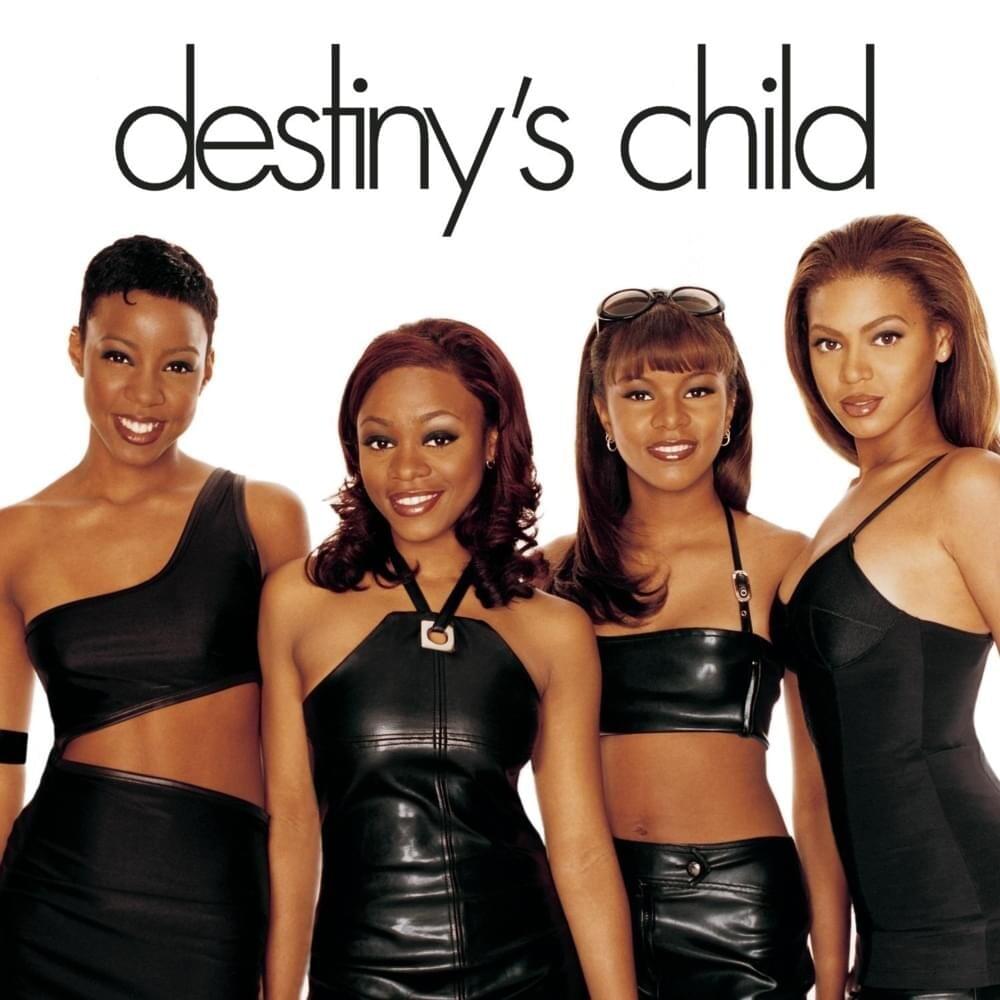
Destiny’s Child – The Entry
In 1998, the American girl-group landscape was still largely shaped by Black R&B acts. Groups were expected to demonstrate vocal credibility, harmonic precision and continuity with the musical traditions from which they emerged. The Spice Girls had recently popularised a different model, built around personality, branding and the immediate accessibility of pop, but that model had not displaced the standards applied to young Black women in the United States. For them, novelty was rarely enough. Visibility had to be preceded by proof.
Destiny’s Child entered this landscape as an unusually prepared group whose technical ability was more developed than its artistic identity. Their debut does not yet contain the coherent language that would later make them culturally unavoidable. It moves between the conventions of the 1990s vocal group and the more rhythmically assertive form of R&B that Destiny’s Child would soon help define. Its purpose is therefore not primarily to announce originality. It is to establish that the group qualifies for entry.
That qualification had been years in the making. Destiny’s Child were presented as new artists, but the members had already spent much of their childhood rehearsing, competing and performing. By the time the public encountered them, they possessed the self-monitoring, bodily discipline and comfort with evaluation of experienced workers. Beyoncé was sixteen when “No, No, No” and the album were released, while the other members were similarly young. Their professional apprenticeship, however, remained largely invisible. The public saw polished teenagers without necessarily seeing the childhood labour required to produce that polish.
This invisibility was charged by race and gender. Black girls are frequently perceived as more mature, more resilient and less in need of protection than they actually are. Their competence can obscure the pressure placed upon them because discipline is mistaken for personality rather than recognised as the result of training. The more convincingly Destiny’s Child performed readiness, the easier it became to forget that they were children working inside an adult institution.
Their girlhood did not disappear. It was presented through precocity. The group offered friendship, coordination, aspiration and the intimacy of girls growing together, but without the uncertainty conventionally associated with becoming. They appeared youthful enough to attract younger listeners and mature enough to satisfy an adult R&B audience. Younger girls could perceive them as attainable older sisters, while adult women could recognise the emotional situations they performed. Their adolescence was not denied, but compressed into a form that was already useful.
Behind that readiness stood an affluent Black family whose resources complicate the mythology of the self-made pop star. The Knowles family did not enter the music industry seeking rescue from poverty. Tina Knowles had created her own income through hairdressing and business ownership, while Mathew Knowles had built a successful corporate career. Their money gave the group access to training, costumes, transport, rehearsal time and, perhaps most importantly, the possibility of continuing after disappointment. Talent could be developed patiently because the family possessed the resources to sustain a project whose commercial return remained uncertain.
This did not place the family outside capitalism. In the United States, there is no meaningful position outside it. Their distinction lay in the way they operated within it. Tina’s salon represented self-employment rooted in Black female cultural life. Her knowledge of hair, clothing and presentation emerged from a Black-owned business whose success depended on understanding Black women from within rather than translating them for an external institution. Mathew brought the techniques of corporate sales, negotiation and organisation. Destiny’s Child emerged from the combination of Black entrepreneurship and professional managerial expertise.
The family’s class position was therefore not based solely on consumption. It was organised around work, ownership and transmission. Economic capital was converted into cultural preparation, and one generation’s professional success became the next generation’s opportunity. Beyoncé inherited more than financial security. She inherited parents who understood that talent required an institution around it.
This work ethic should not be confused with a rejection of structural analysis. Tina and Mathew Knowles worked hard, but their success was also made possible by access, education, family resources and opportunities that remained unevenly distributed. The significance of the family lies not in proving that anyone can succeed through effort, but in demonstrating what becomes possible when Black labour is allowed to accumulate rather than being exhausted by survival. Their achievement was not the isolated emergence of an exceptional child. It was the construction of continuity.
This placed the family within a longer and more contradictory political history. In the late 1960s, Richard Nixon promoted Black capitalism as a response to racial inequality and urban revolt. He encouraged Black ownership, management and private enterprise, presenting property as evidence of opportunity and the foundation of what he called “orderly progress.” The language appeared to recognise Black autonomy, but it narrowed the acceptable meaning of that autonomy. Black advancement could be supported when it took the form of individual ownership within the existing economic order. Collective redistribution, institutional confrontation and political revolt remained outside the approved definition of progress.
Nixon did not invent Black entrepreneurship. Black communities had developed businesses, mutual-aid networks and traditions of economic self-determination long before his administration. What he did was appropriate that history and separate its least disruptive elements from the wider politics of Black Power. Ownership could be celebrated because it redirected collective demands toward individual advancement. The promise was not that the racial distribution of property would be transformed, but that selected Black people might earn a place within it.
This produced a moral division between forms of Black life. The business owner, homeowner and disciplined worker could be recognised as deserving, proof that opportunity existed for those prepared to use it correctly. Those associated with poverty, public assistance, revolt or criminality could be placed on the opposite side of the distinction. Structural inequality was recoded as a test of conduct. Success demonstrated character, while deprivation became evidence that character was absent.
The same political period produced the modern federal War on Drugs. In June 1971, Nixon described drug abuse as America’s “public enemy number one” and announced a new federal offensive. His initial programme included significant investment in treatment and rehabilitation, but it also strengthened the association between drug use, crime and social disorder. Read beside Black capitalism and the wider rhetoric of law and order, the policy helped construct two possible responses to Black discontent: incorporation for those who could be represented as productive and controllable, and criminalisation for those classified as disorderly or dangerous.
These categories were never stable descriptions of reality. They were political judgements about which Black people could be admitted into the national story. The respectable entrepreneur was not simply praised for possessing money. That figure was used to discipline those who did not. If one Black family could advance through ownership, poverty could be attributed to individual failure rather than to the systematic obstruction of Black accumulation.
The Knowles family partly embodied the promise of Black capitalism. Tina had created autonomy through business ownership, while Mathew had advanced through corporate employment. They converted income, professional knowledge and cultural expertise into opportunity for their children. Their story contained every quality that the ideology claimed to reward: work, family investment, enterprise, self-discipline and personal responsibility.
Yet their success also moved beyond the political role assigned to it. They did not merely acquire money as isolated individuals. They transmitted it. Economic capital became training, managerial knowledge, confidence and the expectation that the next generation could exercise authority. Their children did not have to begin from the position their parents had occupied.
American culture has often found Black achievement easiest to celebrate when it appears as an exceptional victory over adversity. That narrative preserves the legitimacy of the system because success must be earned anew by every individual. Intergenerational Black security creates a different problem. It produces children who inherit financial protection, institutional familiarity and the ability to withstand failure. Black advancement no longer appears as an isolated exception. It begins to resemble a durable social position.
Destiny’s Child were the cultural product of that transmission. The Knowles family used wealth to prepare the girls for the mainstream without treating proximity to white culture as the measure of sophistication. Their project remained anchored in contemporary R&B, church-derived vocal traditions, Houston, Black beauty culture and a visual language created partly by Tina Knowles. The record industry did not discover unformed girls and teach them professionalism. It received performers whose family and community had already built a professional structure around them.
This refusal of cultural assimilation gave the project a political dimension whether or not it was announced as such. Blackness remains political because it is not merely an aesthetic choice. It is a social classification that determines how wealth, behaviour and authority are interpreted. The Knowles family could acquire the conventional signs of success while refusing the idea that success should culminate in cultural whiteness. Their money financed an R&B group rather than an escape from Black cultural life.
For many Black listeners, this class position could be recognised as aspirational. Destiny’s Child represented a family investing intensely in its children, a mother creating wealth through her own business, a father transferring corporate expertise into a Black enterprise, and a group entering powerful institutions without presenting Blackness as an obstacle to be overcome. Their success suggested that Black communities already possessed the knowledge required to produce excellence, even when mainstream culture failed to recognise that knowledge as institutional authority.
The album’s sound reflects the position of a group proving that it can satisfy existing standards before attempting to redefine them. Producers including Jermaine Dupri and Wyclef Jean place Destiny’s Child securely within contemporary R&B, moving between smoother vocal arrangements, hip-hop-influenced production and the neo-soul textures circulating at the end of the decade. The material is carefully assembled, but it rarely settles into a singular proposition. Its cohesion comes less from a unified concept than from the discipline of the performances.
The contrast between the two versions of “No, No, No” reveals the transition taking place. The original belongs more clearly to the established vocal-group tradition, allowing atmosphere, melody and harmony to carry the song. The remix reorganises the group around rhythm. The beat becomes more forceful, Beyoncé’s phrasing acquires greater urgency, and the repetition of the title gives the track the conversational directness that would later define much of their work.
The remix does not merely make the song more commercial. It identifies the future Destiny’s Child inside a group still being presented through older conventions. Their breakthrough occurs when vocal credibility is joined by rhythmic personality. Destiny’s Child would eventually become distinctive because they could transform speech, irritation, refusal and syncopation into melody. On the debut, that quality appears as a discovery rather than a complete system.
Their vocal arrangements already reveal a clear hierarchy. Beyoncé functions as the principal narrative voice, while Kelly Rowland, LeToya Luckett and LaTavia Roberson provide the harmonic body that allows the lead to appear larger than an individual singer. This follows a familiar R&B convention in which one voice anchors the collective, but the family management surrounding the group gives the arrangement another meaning. The group is socially presented as a unit while musically organised around a centre.
At this stage, that hierarchy still protects the collective rather than openly threatening it. Beyoncé gives the songs continuity and recognisability, while the other members prevent her authority from appearing as a solitary claim. The girl group makes individual ambition safer by distributing it across an image of sisterhood. A highly trained and visibly ambitious Black teenage soloist might have been interpreted as excessive. Within a group, the same qualities could be understood as teamwork and collective aspiration.
Harmony consequently carries both a musical and a social function. It reassures the audience that prominence has not disturbed cohesion. The voices blend even when authority is distributed unevenly. Destiny’s Child sell not only songs, but the promise that hierarchy and sisterhood can exist without conflict.
The album’s lyrics reproduce a similar tension between ability and authority. Its songs revolve around romantic disappointment, uncertainty, negotiation and emotional resilience. These subjects are not foreign to teenage girls, but they are processed through an adult R&B vocabulary. The singers rarely appear to be encountering emotion for the first time. Confusion has already been converted into analysis, while disappointment arrives with the composure of experience.
Most of the material is written and produced by adults, predominantly men. The issue is not simply that adults wrote relationship songs for teenagers, a common practice throughout popular music. It is that the girls are given responsibility for performing emotional knowledge without possessing much authority over how that knowledge is formulated. They are trusted to make romantic struggle convincing, but not yet to determine its meaning.
The female speaker is frequently required to manage instability. Male inconsistency provides the situation, while her emotional intelligence provides the solution. Maturity is demonstrated through the ability to interpret disappointment, preserve dignity and continue negotiating. The songs train the girls’ voices in relational management before the group develops the language of refusal that will define its second album.
Yet the debut is not entirely passive. “No, No, No” already contains the act of negation that will become central to Destiny’s Child’s identity. What the album lacks is not resistance, but coherence. Moments of refusal coexist with conventional longing and endurance because no unified female perspective yet organises the project. They possess a recognisable performance identity before they possess a fully articulated worldview.
Visually, Destiny’s Child are presented as Black teenage girls rather than miniature adult divas. Their coordinated clothing, hair, choreography and group formation preserve youth as part of the proposition. At the same time, every element is controlled. They can be playful without appearing unserious, attractive without appearing unruly, and culturally specific without surrendering professional polish.
Tina Knowles’s contribution makes this presentation especially significant. The group’s image did not emerge entirely from label executives deciding how young Black women should look. It was partly created through a Black female entrepreneurial tradition in which beauty, commerce and community knowledge were already intertwined. Her styling asserted that Black cultural expression did not need to be corrected by white institutions before becoming professional.
The rollout remained centred on credibility rather than spectacle. “No, No, No” gave the group its principal point of recognition, while subsequent singles tested different versions of their identity without producing an equally decisive response. The album’s commercial trajectory was gradual. Rather than arriving as an immediate blockbuster, it gained value as Destiny’s Child’s later success encouraged listeners to return to the beginning. Its eventual status as a sleeper success reflects both the strength of the initial hit and the uncertainty surrounding the wider proposition.
The United Kingdom response offered an early indication that the group could travel beyond the American R&B market. “With Me” received greater attention there than it did in the United States, reflecting the British market’s established appetite for American R&B. This international reception did not yet transform Destiny’s Child into a global pop act, but it suggested that cultural specificity need not restrict commercial movement.
The debut ultimately succeeds because it proves more than it declares. It demonstrates that Destiny’s Child can sing, harmonise, perform and carry the expectations placed upon a major R&B group. It also shows that a Black family could privately construct much of the infrastructure required to make its children institutionally credible.
But qualification is not the same as sovereignty. The girls earn visibility without controlling the perspective through which they are seen. Beyoncé is prominent without being fully autonomous. The group possesses technical authority without a unified creative language. Their excellence grants admission, but the standards of admission remain largely intact.
This is the central contradiction of deservingness. Exceptional preparation can make exclusion more difficult, but it does not redistribute power by itself. Destiny’s Child satisfy every condition required to enter the industry, while the industry retains the authority to decide what their abilities should mean.
The album’s caution is therefore not evidence of limited ambition. It reflects an unequal distribution of risk. The label and producers rely on familiar sounds, established themes and recognisable formulas, while the family and the girls have already carried years of financial uncertainty, childhood labour and repeated evaluation. The institution takes a measured artistic risk because the performers have absorbed the greater danger in advance.
Destiny’s Child is consequently not a story of innocence waiting to become empowerment. It is the story of qualification. Black girlhood is made investable through family capital, professional discipline and cultural continuity. The group arrives not as a blank product of the record industry, but as the result of a Black bourgeois infrastructure capable of transmitting advantage without cultural assimilation.
The debut secures their place by proving that they can master an inherited language. The Writing’s on the Wall will begin the more consequential process of using that mastery to speak in one of their own.

 Elemental Emancipation
Leave a comment