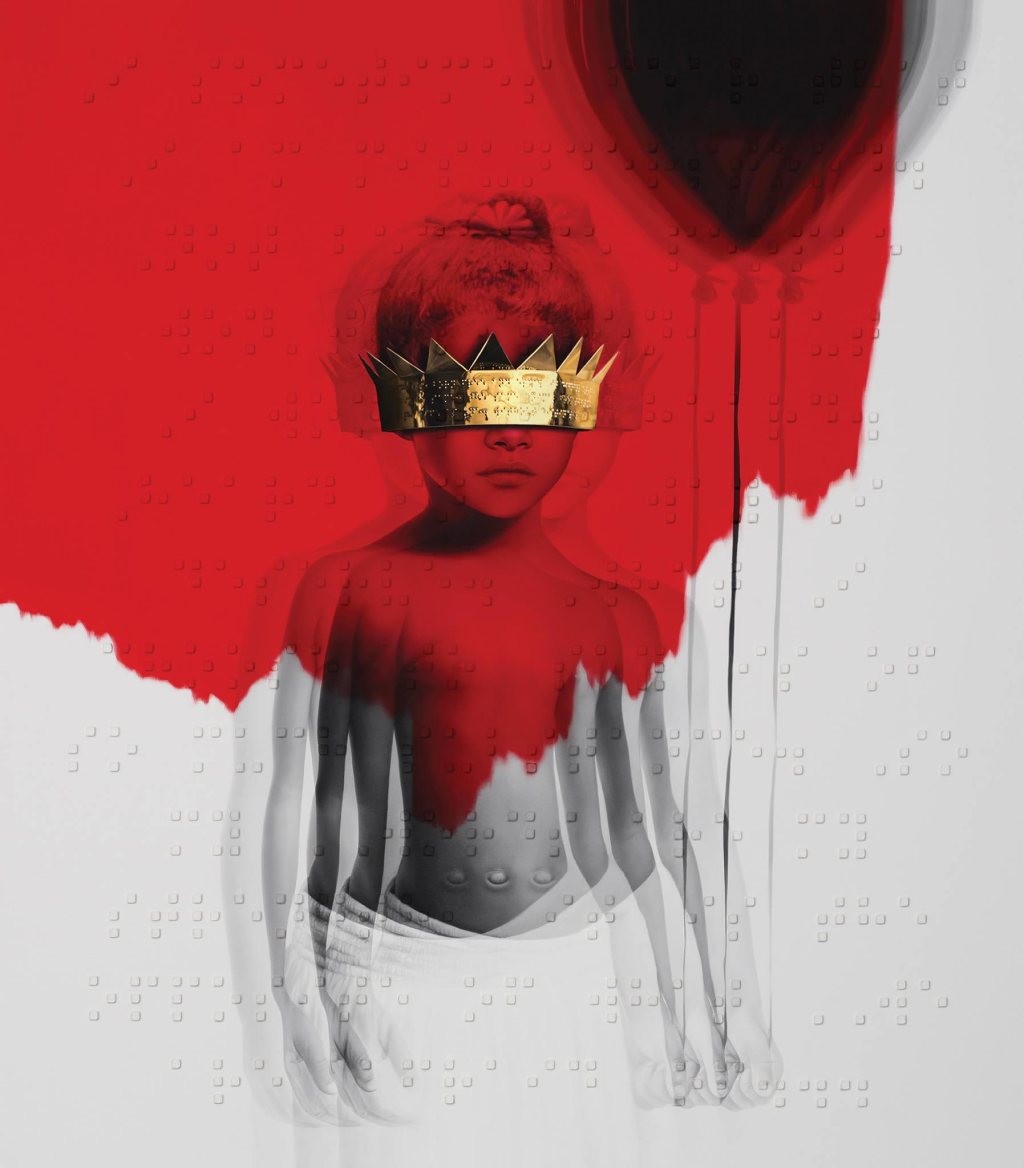
ANTI – The Refusal
After Unapologetic, the established rhythm fractures. For the first time since 2009, November arrives without a new Rihanna album. The annual Q4 cycle, which had become embedded in both industry scheduling and audience expectation, is interrupted. The absence is conspicuous precisely because recurrence had been institutionalised.
Anticipation persists throughout 2013, yet no project materialises. The interruption signals more than delay; it destabilises the infrastructure that had defined her first cycle.
Her presence at the MTV Video Music Awards that year crystallises this shift. Rather than performing or anchoring the ceremony, she appears as spectator. The styling is deliberately understated: jeans and a white T-shirt. In contrast to the saturated palettes and editorial staging of previous eras, the image suggests withdrawal from spectacle. The pop constant becomes observer.
The gesture is subtle but symbolically potent. For an artist whose identity had been tied to annual reinvention and Q4 dominance, restraint becomes a statement.
In January 2015, “FourFiveSeconds” is released, marking her first major single in over two years. The collaboration with Kanye West and Paul McCartney suggests ambition and cross-generational positioning. The track achieves substantial visibility, peaking at number four in the United States. Yet for an artist whose previous cycle had been defined by repeated number ones, the result feels transitional rather than dominant.
Subsequent releases complicate the trajectory. “Bitch Better Have My Money” embraces abrasive minimalism and confrontational posture, but fails to enter the top ten. “American Oxygen,” thematically reflective and politically inflected, does not reach the top forty. The sequence lacks consolidation.
By this stage, the industry landscape has shifted decisively toward streaming. The conversion model that had underpinned her earlier dominance — a lead single generating momentum toward a fourth-quarter album — no longer functions with the same predictability. Radio impact alone is insufficient. Playlist integration, viral repeatability, and sustained digital engagement begin to outweigh the traditional metrics that had once guaranteed album-scale returns.
The infrastructure that supported the 2009–2012 cycle has eroded.
At this stage, the projected architecture of the forthcoming album begins to shift. Kanye West had initially been associated with the project in an executive capacity, suggesting a tightly curated sonic direction. However, the eventual trajectory indicates a reorientation. Rather than adhering to an externally anchored framework, the process appears to decentralise. The album’s authorship becomes less visibly delegated and more internally consolidated.
This reconfiguration is accompanied by delay. Following the early 2015 singles, several months pass without a definitive anchor track. Public anticipation intensifies, yet no clear release structure materialises. The silence contrasts sharply with the disciplined annual cycles that had characterised her previous era.
The interruption is not incidental. It signals the dissolution of the prior infrastructure. Velocity gives way to hesitation. The machinery pauses.
With Anti, the release logic itself transforms. The lead single and the album arrive in near proximity, disrupting the extended validation model that had structured her earlier cycles. The rollout is minimal by her own historical standards. “Work” anchors the launch, followed by “Kiss It Better” and “Needed Me,” yet the sequencing lacks the elaborate escalation of previous eras. The project appears rather than being constructed publicly.
Visually and positionally, she withdraws from overt pop artefacts. There is no hyper-saturated palette, no theatrical rupture, no seasonal machine. The persona is presented with restraint. The spectacle is reduced. The emphasis shifts from event to atmosphere.
The timing aligns with broader industry recalibration. In 2016, albums perceived as personal or internally authored receive significant recognition. Adele’s 25 and Beyoncé’s Lemonade demonstrate that scale and intimacy are no longer mutually exclusive. The market rewards coherence and emotional clarity alongside streaming metrics.
Sonically, Anti embraces multiplicity with cohesion. “Work” leans directly into dancehall, foregrounding Caribbean rhythm without filtering it through pop gloss. The remainder of the album oscillates deliberately: ballads such as “Close To You” and “Love on the Brain,” the latter emerging as a single through organic streaming traction rather than pre-planned rollout; “Higher,” drawing from pop-soul inflections; “Same Ol’ Mistakes,” anchored in alternative pop; and minimalist alternative R&B tracks such as “Needed Me” and “Yeah, I Said It.” The heterogeneity no longer feels like accumulation. It feels intentional.
Provocation remains, but it is subdued. In the video for “Needed Me,” she enacts retaliation without the moral panic that accompanied “Man Down.” The cultural context has shifted. By this stage, she is no longer perceived as a figure within adolescent pop discourse. The reaction is less defensive, more interpretive. The conversation evolves.
Visually, the Anti era is even more restrained than Unapologetic. The reduction of overt aesthetic thesis continues. “Kiss It Better” draws from a late 1980s and early 1990s visual grammar: black-and-white cinematography, soft focus, close framing, and minimal staging. The imagery feels classical without being explicitly nostalgic. It references a period before the hyper-digital pop spectacle became dominant, yet it avoids costume or overt retro stylisation. The effect is temporal ambiguity rather than era recreation.
“Needed Me” functions as the most narratively developed visual of the cycle. Its atmosphere is nocturnal and deliberate, culminating in an act of retaliation that is neither sensationalised nor framed as moral spectacle. Scenes that might have provoked broadcast censorship earlier in her career are now integrated without comparable controversy. The cultural climate has shifted; the imagery is received as statement rather than scandal.
“Work” adopts a dual structure. One version situates her within a Caribbean party environment, foregrounding communal dance and rhythmic continuity. The second is more intimate and suggestive, aligning loosely with contemporary discourses around bodily autonomy. The provocation is present but understated. It does not seek shock; it normalises sensual agency.
Across the era, spectacle yields to atmosphere. The videos do not announce reinvention. They reinforce presence.
The reception of Anti confirms the structural shift. The album performs strongly within the streaming ecosystem while maintaining material physical presence. If Good Girl Gone Bad represented her most traditionally commercial apex within the pre-streaming model, Anti becomes her first unequivocal streaming-era success.
The metrics change, but the authority persists.
Unlike earlier cycles, where momentum was engineered through seasonal release timing and sequential hit validation, Anti thrives on sustained digital engagement. Tracks accumulate organically. “Love on the Brain” emerges as a single through heavy streaming traction rather than strategic rollout. The album benefits from replayability rather than density of radio premieres.
In this context, Anti reads as departure without decline. She exits the annual machinery not in exhaustion but in consolidation. The project carries the coherence and restraint of an auteur statement rather than the urgency of a seasonal event.
The consequence is significant. Having mastered the pre-streaming hit machine and navigated its collapse, she concludes this phase with an album that prioritises atmosphere, authorship, and tonal cohesion over industrial velocity. It functions less as continuation and more as farewell to the infrastructure that shaped her first decade.


Leave a Reply