
Talk That Talk – The Compression
By 2011, maximalist dance-pop no longer monopolised commercial scale. Adele’s “21,” driven by “Rolling in the Deep” and “Someone Like You,” achieved a level of sustained success not seen for years. Its vocal centrality and emotional directness offered a counterweight to club-driven pop, demonstrating that intimacy could coexist with, and eventually surpass, EDM-led-tracks within the album market.
In the aftermath of the 2008 financial crisis, escapist spectacle did not disappear, but its exclusive claim over commercial scale gradually weakened. The industry rediscovered that different sectors of the audience sustained different forms of consumption. Success did not have to be organised solely around youth, radio, and individual downloads. Older listeners were more inclined to purchase physical records and complete albums, giving cross-generational acts a form of commercial durability that the youth-centred singles market could not always reproduce.
Talk That Talk occupies a particular position within her catalogue. It arrives as the sixth album of the reported initial six-album contract signed at the beginning of her career. Structurally, this placement is significant. Yet the project itself is comparatively concise and, in parts, suggestive of accelerated production. The release schedule remains compressed, and the album’s brevity contrasts with the scale of its predecessors.
The November release pattern during this period is unlikely to be coincidental. Rated R and Loud had both benefited from late-year positioning, allowing momentum to extend into the Christmas retail cycle. In an era where physical sales still contributed significantly to revenue, the fourth quarter remained commercially decisive.
Talk That Talk follows the same calendar logic. A late November release maximises exposure during peak retail weeks, particularly for an act of her scale whose albums functioned not only as youth consumption but as mainstream pop commodities. The timing allows singles to dominate radio while the album benefits from gift-driven purchasing behaviour.
Within a contracting industry, release scheduling becomes part of infrastructure. November offered a window in which velocity, chart performance, and physical sales could converge. The repetition of this pattern across consecutive years suggests strategic optimisation rather than coincidence.
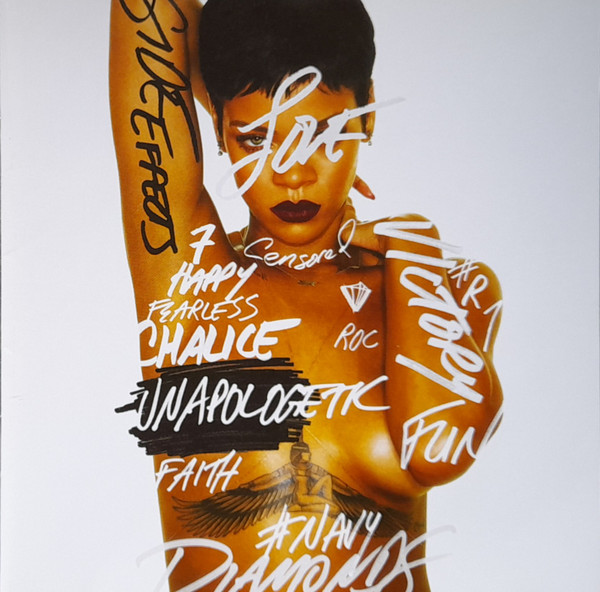
The rapid arrival of Unapologetic less than a year later further complicates the narrative. The continuity between the two projects suggests that the contractual cycle did not conclude in a conventional manner. Whether through renegotiation, extension, or strategic restructuring, the release pattern indicates that the initial framework was either expanded or recalibrated.
In this sense, Talk That Talk reads less as an endpoint and more as a hinge between phases.
Sonically, the album balances electronic propulsion with reduced gloss. “We Found Love” and “Where Have You Been” draw on electronic structures rather than straightforward dance-pop exuberance, aligning with the growing global EDM wave while avoiding the cartoon brightness of the previous era. Simultaneously, tracks such as “Cockiness” and “Birthday Cake” foreground stripped-back, hip-hop-inflected production, amplifying her confrontational sexual persona.
The project also gestures toward alternative sensibilities. “Drunk On Love” samples The xx, integrating atmospheric minimalism into her mainstream framework. The choice signals permeability between pop infrastructure and indie-adjacent textures, suggesting an affinity for more restrained sonic palettes even within a hit-driven context.
A handful of ballads, including “Farewell” and “We All Want Love,” complete the structure. While not foregrounded as commercial drivers, they preserve emotional continuity, ensuring that the album does not collapse into pure provocation or club propulsion. The consolidation is therefore multi-layered: electronic scale, hip-hop minimalism, alternative sampling, and restrained vulnerability coexist within a compressed format.
Within this context, Rihanna proposes a subtle aesthetic shift. The hyper-saturated femininity of Loud recedes. The styling becomes less theatrical, drawing on a loose grunge revival vocabulary associated with early 1990s references. The palette is less artificial, the hair returns to a natural tone, and the visuals appear deliberately less polished. The femininity remains, but it is not hyperfeminine. It is casual, self-assured, and at times abrasive.
The visual component of “We Found Love” reinforces this tonal complexity. The video juxtaposes euphoric intimacy with volatility and substance use, drawing on aesthetic references reminiscent of films such as Requiem for a Dream. The imagery does not present club euphoria as uncomplicated celebration. Instead, it frames intensity as both intoxicating and destabilising. The visual becomes integral to the single’s impact, amplifying its emotional charge and contributing to its global resonance.
Within a broader cultural context, the project reflects a generational atmosphere marked by instability rather than innocence. For a cohort of young adults navigating the aftermath of economic crisis and accelerated digital life, emotional intensity and excess coexisted with fatigue. The oscillation between euphoria and confrontation in her work captures that tension. The electronic highs of “We Found Love” and the abrasive sexuality of tracks such as “Cockiness” do not propose escapism in its purest form; they stage experience at its extremes.
Talk That Talk introduces a deliberate roughness into her catalogue. The inclusion of “Birthday Cake” in an unfinished form is particularly telling. Earlier projects privileged polish and structural completeness. Here, fragmentation becomes aesthetic gesture. The track’s brevity and rawness align with the album’s broader grittiness, reinforcing a persona less concerned with refinement and more comfortable with abrasion.
By 2011, she had become a staple of the mainstream industry. Six albums in six years had repositioned her from emerging act to infrastructural constant. The accumulation of number one singles consolidated a singles-driven career that was no longer provisional but recognised. Velocity had shifted from strategy to expectation.
Talk That Talk also reflects a reversal of the logic that governed Good Girl Gone Bad. In 2007, sustained hit density was required to convert listeners into album buyers. The project proved itself progressively. By contrast, Talk That Talk is propelled primarily by the scale of “We Found Love.” The single precedes and carries the album, rather than the album constructing its authority through multiple sequential validations. The direction of causality shifts. The hit generates the album’s momentum.



Leave a Reply