Unapologetic – The Politics of Exposure
By 2012, the saturation of maximalist dance-pop begins to coexist with a more pronounced appetite for introspection. Adele’s 21 continues to dominate into a second year, reinforcing the commercial viability of vocal-centred, emotionally direct material. Simultaneously, artists such as Lana Del Rey gain visibility through inward-facing, atmospheric pop, suggesting that the market is no longer defined solely by euphoric propulsion.
This does not signal the disappearance of electronic music. Rather, it marks a tonal adjustment. Many of the year’s major singles retain electronic frameworks while incorporating heightened emotional resonance. Tracks such as “Titanium,” featuring Sia, combine EDM structures with lyrical themes of resilience and vulnerability. The integration of introspection into high-BPM production reflects a subtle recalibration rather than rupture.
Within this landscape, the binary between escapism and inwardness softens. Electronic scale and emotional gravity begin to coexist more openly in the mainstream.
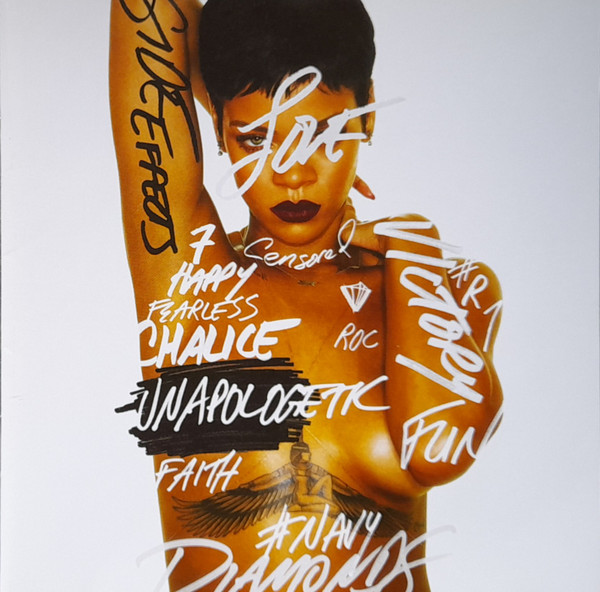
With Unapologetic, the visual architecture shifts once again, though less dramatically than in previous cycles. The era does not rely on hyper-saturated colour schemes, nor does it deploy the stark severity of Rated R. The grunge inflections of Talk That Talk recede. Instead, the imagery presents her in a more direct manner: fashion-forward, editorial, but without overt thematic costume.
The persona appears less constructed around a singular aesthetic proposition and more consolidated around recognisability. She is not framed as caricature or rupture. She is framed as herself within the existing pop infrastructure. The editorial quality remains, but it is no longer anchored to a specific visual thesis. The spectacle softens into presence.
The visual executions reinforce this restraint. “Stay” presents her in an austere setting, immersed in a bathtub, the camera lingering on emotional exposure rather than choreography or stylisation. “Diamonds” adopts a cinematic approach built around elemental imagery, invoking earth, air, fire, and water without resorting to overt narrative theatrics. The symbolism is expansive but not excessive.
“Pour It Up,” by contrast, is deliberately direct. The video stages strip-club bravado traditionally coded as male performance. Rather than positioning herself as object within that framework, she assumes the posture typically reserved for male performers. The gaze is redirected. The simplicity of the staging underscores the point: spectacle is not required to assert dominance.
In this sense, Unapologetic reads less as transformation and more as stabilisation. The era does not demand reinvention. It consolidates the persona within a framework that no longer requires overt aesthetic signalling.
Sonically, Unapologetic does not pursue coherence in the traditional sense. The album appears rapidly assembled, yet it is more expansive than Talk That Talk. Rather than advancing a singular aesthetic thesis, it functions as synthesis. The project traverses pop-urban maximalism on “Phresh Out The Runway,” electronic midtempo restraint on “Diamonds,” stark balladry on “Stay” and “What Now,” and reggae-inflected textures on “No Love Allowed.” The heterogeneity is not accidental. It consolidates the spectrum she had occupied over the preceding years.
Compared to her immediate predecessors, the emphasis on overt EDM exuberance diminishes. Electronic elements remain present, but they frequently operate at slower tempos or within midtempo frameworks, as heard on tracks such as “Love Without Tragedy.” The propulsion softens. The energy disperses rather than explodes.
The rollout reflects a growing confidence in structural momentum. Following the Talk That Talk model, the album does not rely on a prolonged succession of equally dominant singles. “Diamonds” and “Stay” emerge early as defining moments. Neither competes aggressively for dance-floor saturation. Instead, they privilege expansiveness and vulnerability. The shift suggests that she is no longer compelled to match the tempo of club culture; the audience, like the market, has moderated.
At the same time, the confrontational streak persists. “Pour It Up,” the era’s hip-hop-coded single, foregrounds braggadocio and material assertiveness in a manner traditionally reserved for male performers. The tone is deliberately provocative, echoing contemporary strip-club anthems while reframing the posture through female authorship. The explicitness is not incidental; it reinforces autonomy within a slower sonic landscape.
Lyrically, Unapologetic suggests the completion of an arc. The album opens with “Phresh Out The Runway,” a track that gestures toward self-awareness. The line “How can you be so hood, but you’re so fucking pop” encapsulates the hybridity that had defined her trajectory. The tension between pop ubiquity and urban-coded credibility is not denied; it is acknowledged.
Moments of vulnerability are foregrounded without theatrical framing. “Stay,” a sparse duet originally not fully intended for external release, places emotional exposure at the centre of the project. Its minimalism contrasts sharply with the maximalist infrastructure that had sustained earlier eras.
The selection of “Diamonds” as lead single is similarly telling. Reportedly unexpected by some collaborators who had proposed more uptempo material, the track privileges expansiveness and restraint over club propulsion. The lyrics, penned by Sia, evoke distance and transcendence rather than confrontation. The tone suggests elevation rather than escalation.
On “Mother Mary,” she invokes Catholic language of guilt and introspection, introducing spiritual vocabulary into a catalogue previously dominated by relational and sensual themes. The gesture broadens the thematic register beyond interpersonal dynamics.
“No Love Allowed” further distances the narrative from victimhood. Rather than revisiting trauma, the track articulates refusal and forward movement. The posture is not reactive; it is declarative.
Taken together, these lyrical choices give the album the quality of resolution. Unapologetic does not introduce a new conflict. It consolidates prior tensions and allows them to settle. The project feels less like escalation and more like closure.
Unapologetic becomes her first studio album to debut at number one in the United States. The distinction is significant. For an artist who had already accumulated an extraordinary number of chart-topping singles, album supremacy had remained structurally secondary. The milestone therefore reads less as breakthrough and more as delayed alignment between singles dominance and album validation.
By this stage, her international stature was no longer in question. She had operated for several consecutive years as a global pop constant, maintaining annual release cycles, cross-market visibility, and sustained hit density. The strategy underpinning this ascent was neither conceptually elaborate nor sonically avant-garde. It relied on velocity, adaptability, and strategic calibration to prevailing market currents.
Unapologetic confirms that this model had reached maturity. The album’s commercial peak does not derive from radical reinvention but from accumulated authority. The international pop act she had incrementally constructed over six years no longer required overt repositioning. The infrastructure was established.





Leave a Reply