Doll Domination – The Dependence
Following the success of PCD, the Pussycat Dolls appeared to have established a formula that could be extended indefinitely. The group had sold millions of albums, produced several international singles and transformed a former burlesque troupe into one of the most recognisable pop formations of the decade. Yet the success concealed a structural limitation. The Pussycat Dolls had been designed to produce an immediate impact, not necessarily to sustain a conventional career. Their musical identity depended almost entirely on Nicole Scherzinger, while the other members supplied the movement, scale and visual cohesion surrounding her. Once the first campaign had exhausted most of the material capable of carrying the concept, the group had little internal development on which to build a second project.
The initial solution was not to strengthen the Pussycat Dolls, but to remove Nicole from them. Her predominance on the first album had encouraged the belief that the group had already introduced her as an individual star. She had sung nearly all of the material, occupied the centre of the choreography and become the member most readily identified by the public. A solo career therefore appeared less like a departure than the completion of a process that had begun with “Don’t Cha”.
The assumption confused visibility with independence.
Nicole had been made central to the Pussycat Dolls, but she had not necessarily been established outside them. The group had taught audiences where to look without giving them a complete understanding of who she was as an autonomous artist. Her voice was familiar, her face was visible and her ambition was evident, yet the musical and visual proposition surrounding her still belonged to the Pussycat Dolls brand. She had been positioned as the star of a product without being given the authorship necessary to become a product of her own.
The stalled release of “Her Name Is Nicole” exposed that distinction. Several singles were launched, substantial recording sessions took place and a wide range of producers were assembled, but the project failed to generate the commercial momentum expected from a singer who had already appeared to lead one of the world’s most successful groups. The public recognised Nicole Scherzinger, but recognition did not automatically translate into attachment. Removed from the Dolls, she entered a crowded market of female solo performers without a sufficiently distinct identity to explain why the audience should follow her there.
The failure was particularly revealing because Nicole seemed to possess every advantage. She had the voice, the image, the industry support and an established global platform. Yet the solo campaign demonstrated that her prominence had been relational. She appeared exceptional within the Pussycat Dolls because the entire formation was organised to make her exceptional. The other women created movement around her, scale behind her and contrast beside her. Their synchronisation transformed Nicole from an individual singer into the centre of a spectacle.
The Dolls had not simply accompanied her stardom. They had produced the conditions through which it could be perceived.
Rather than reconsidering this relationship, the label reversed the direction of the project. Material recorded during Nicole’s solo sessions was redirected towards the group, and the Pussycat Dolls were reactivated as the commercial framework through which those songs could be released. “Doll Domination” was therefore not conceived entirely as the natural continuation of “PCD”. It was partly assembled from the remains of an individual career that had failed to launch as intended.
The difference between the two albums is fundamental. On “PCD”, the concept preceded the music. Robin Antin’s formation already possessed an image, a hierarchy and a performance language. Songs, covers and producers were gathered to demonstrate what the Pussycat Dolls could become as a recording act. On “Doll Domination”, much of the music preceded the renewed concept. The Pussycat Dolls identity was placed around existing material in order to restore its commercial viability.
The first album used songs to establish the product. The second used the product to recover the songs.
This reversal intensified the hierarchy rather than correcting it. Carmit Bachar had left the formation, removing one of the few members who had contributed a noticeable additional vocal presence. Melody Thornton, who had previously supplied ad-libs and occasional moments of vocal distinction, was not developed into a genuine secondary singer. Her role diminished instead. The remaining members were not integrated more substantially into the musical structure, despite having spent several years performing as internationally recognised members of a successful girl group.
The label could have used the second album to justify the continuation of the formation. It could have developed different vocal roles, created interactions between the members or given the group an identity that extended beyond Nicole’s lead. Instead, it treated the success of the first album as proof that the original concentration of power should be reproduced more aggressively. Nicole did not simply remain the principal vocalist. She increasingly became the only meaningful musical presence.
This decision made less sense in 2008 than it had in 2005. The first album had introduced the Dolls according to a clear division of labour. Nicole carried the songs, Melody and Carmit provided limited vocal support, and the other members completed the image. However unequal, the arrangement corresponded to the original proposition. By the time of “Doll Domination”, the women were no longer anonymous dancers entering a new recording project. They had appeared in videos, interviews, performances and an extensive international tour. The audience had been encouraged to recognise them as members of a group, while the music continued to deny the relevance of that recognition.
The contradiction became more visible because the Pussycat Dolls were now being asked to occupy two incompatible forms. Publicly, they were presented as an established girl group returning with a second album. Musically, they functioned increasingly as Nicole Scherzinger accompanied by a collective image. The first album had used the appearance of a group to introduce one central singer. The second retained that appearance after the attempt to establish the singer independently had failed.
The other Dolls consequently became more important to the product at the same moment that they became less important to the music.
Their contribution belonged primarily to the visual field. They supplied choreography, physical discipline, synchronisation and the impression of abundance that distinguished the Pussycat Dolls from an ordinary solo act. Their bodies created the environment through which Nicole’s centrality remained intelligible. Yet because this labour did not take the form of lead vocals, songwriting or production, it could be treated as secondary. The music industry recognised Nicole’s voice as the artistic contribution while presenting the collective image as replaceable decoration.
The failure of “Her Name Is Nicole” revealed the weakness of that distinction. Once the collective image was removed, the supposedly secondary labour proved commercially indispensable. Nicole’s recordings could be returned to the market only after the familiar formation had been placed around them. The other women were considered unnecessary to the creation of the music but necessary to its successful presentation.
Their labour was therefore essential precisely because it was not acknowledged as central.
This does not transform the remaining Dolls into hidden musical authors of Doll Domination. It instead reveals that a pop product is constructed through more than the recording itself. The Pussycat Dolls were sold through movement, repetition, visual contrast and the multiplication of femininity across several bodies. Nicole supplied the voice, but the group supplied the architecture through which that voice acquired its commercial meaning.
“Doll Domination” depended on this architecture while offering the other members little opportunity to alter it. The individual songs attached to the deluxe edition did not meaningfully redistribute power. They separated the women rather than integrating them. Each member could briefly occupy an isolated space, but the principal album still failed to demonstrate why these performers belonged together as a musical collective. The tracks functioned as symbolic acknowledgements of individuality without changing the structure that rendered most of those individualities inaudible.
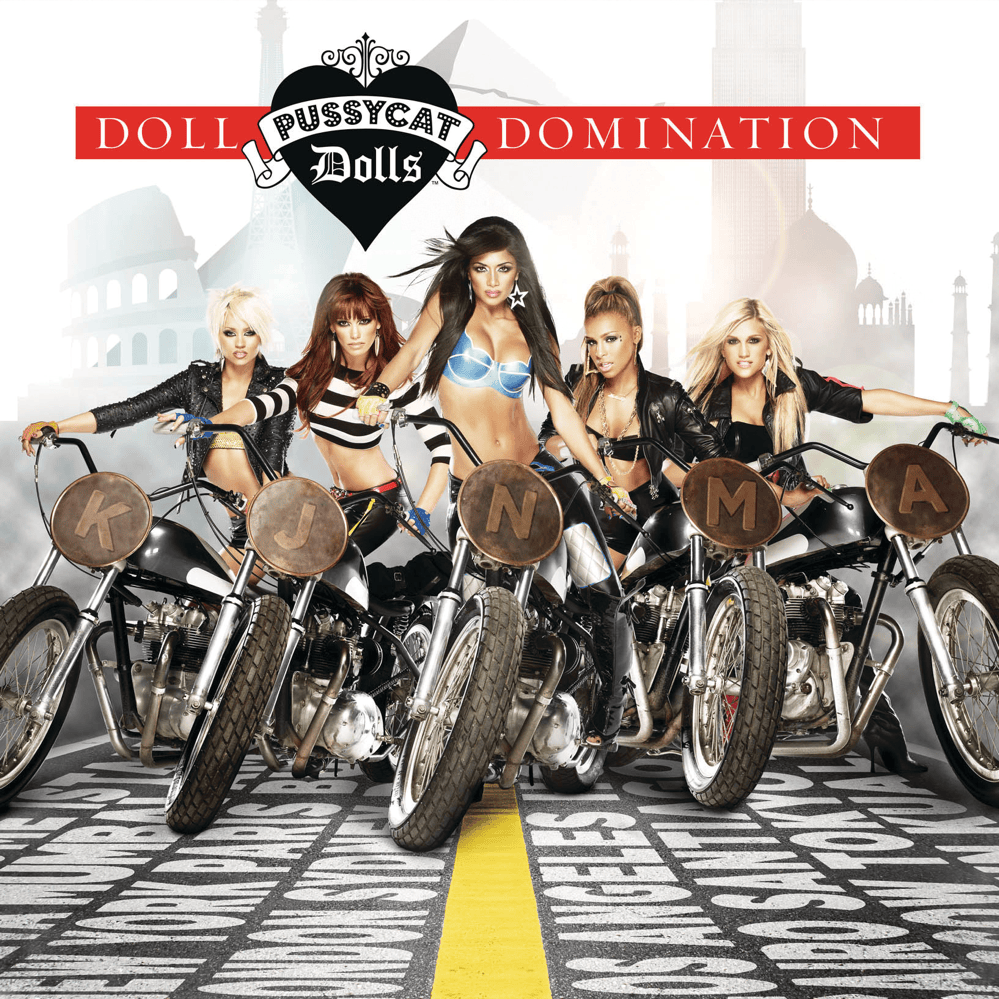
The album’s title suggested that the Dolls had returned with greater control, ambition and reach. The cover reinforced the proposition by placing each woman on a motorcycle bearing her initials, presenting the members as separate personalities moving forward together. Yet the music contradicted the image. The women were visually individualised at the precise moment when the recording process concentrated itself even further around Nicole.
The title therefore became unintentionally ironic. The Dolls did not dominate the album. Most of them barely participated in its central musical identity. Nicole appeared to dominate, but her return itself demonstrated the limits of that power. She possessed almost every vocal advantage within the group, yet had been unable to transfer those advantages into a stable independent career. Her dominance over the other members did not release her from dependence on the collective brand.
Nicole was privileged within the structure, but she did not control the structure.
This distinction is essential. Her position cannot be reduced either to victimhood or complete power. She received opportunities unavailable to the other members, including a solo campaign, extensive recording sessions and continued priority within the group. At the same time, the commercial system surrounding her could redirect her individual work, return her to the Dolls and use the collective identity to recover investments made in her solo career. She stood above the other women while remaining beneath the institutions that determined where and how her voice would be sold.
The hierarchy therefore extended beyond the familiar opposition between Nicole and the remaining Dolls. The other members depended on Nicole for musical presence because the project had been designed around her voice. Nicole depended on the other members for the visual structure that distinguished her from an increasingly crowded field of solo performers. All of them depended on a label capable of moving songs between the individual and the group according to where those songs retained the greatest commercial value.
The Pussycat Dolls brand became a form of collateral. It absorbed the risk created by Nicole’s unsuccessful solo launch and allowed recordings associated with that campaign to be presented as the return of an already successful group. The familiar name reassured radio, television and international markets. The other women restored the visual proposition. Nicole resumed the position from which the audience already understood her.
What appeared to be a comeback was therefore also a commercial recovery operation.
This explains much of the fragmentation within “Doll Domination”. The album was not built from a single renewed understanding of what the Pussycat Dolls should become. It combined material emerging from Nicole’s solo ambitions with songs intended to preserve the existing group identity, tracks responding to the transition towards electronic pop and ballads designed to broaden the emotional range of the project. The number of producers, genres and potential singles created an impression of scale, but not necessarily of direction.
“PCD” had also been assembled from different sources, including several covers, yet the album possessed a clear function. Every song contributed to the introduction of the Pussycat Dolls as a product. The second album lacked that certainty because the product no longer required an introduction. It required a justification.
The title promised domination, but the music frequently communicated uncertainty. “When I Grow Up” offered the clearest articulation of the group’s new position. The song replaced the earlier focus on desirability with a fantasy of fame itself. The desired object was no longer simply male attention, but public recognition, magazine visibility and the transformation of the self into an image consumed by everyone.
The single was particularly appropriate for a project created through the failure of an individual launch. Nicole had achieved fame, but not in the form she had expected. She was internationally recognisable, yet that recognition remained attached to a collective identity she had been prepared to leave. “When I Grow Up” celebrated the fantasy of becoming famous while Doll Domination exposed the limits of fame without an autonomous brand.
The song also captured a broader transition in popular culture. The Pussycat Dolls had emerged during an era in which desirability remained one of the principal aspirations offered to women in mainstream pop. By 2008, visibility itself was becoming the objective. Reality television, celebrity magazines and the early expansion of social media were turning public recognition into a form of achievement detached from any specific profession. The dream was not merely to sing, dance or perform. It was to become known.
The Pussycat Dolls were exceptionally suited to this transition because their identity had always depended more on image than on collective musicianship. Yet the same structure that made them appropriate representatives of celebrity culture prevented them from developing as a group. They could embody fame, but they could not convincingly narrate shared artistic growth. The brand could expand, the rollout could continue and the visual campaign could become more elaborate, but the internal musical relationship remained largely unchanged.
The album also arrived as the commercial environment that had produced the group was beginning to shift. The urban pop centre of the mid-2000s was giving way to a more electronic form of mainstream music. Dance-pop was becoming brighter, harder and increasingly synthetic. New performers were entering the market with identities specifically constructed for that transition, while the Pussycat Dolls remained tied to the producers, vocal arrangements and visual codes that had defined the preceding period.
“When I Grow Up” adapted effectively to the change, using an aggressive electronic production that made the group sound more mechanical and contemporary. Other moments on the album remained connected to the declining urban-pop framework. The result was neither a decisive reinvention nor a coherent continuation. “Doll Domination” negotiated between the market that had made the group successful and the one that was beginning to replace it.
This uncertainty encouraged the project to expand rather than clarify itself. New editions, additional tracks and revised singles prolonged the campaign. “Jai Ho! (You Are My Destiny)” eventually supplied one of its largest international successes, but its credit further exposed the hierarchy the album had attempted to contain. Nicole was named separately alongside the Pussycat Dolls, occupying the contradictory position of being both inside the group and distinguished from it.
The formulation made explicit what “Doll Domination” had already revealed. Nicole was necessary to the Pussycat Dolls, but the Pussycat Dolls were equally necessary to Nicole. The industry continued to present her as the individual star emerging from the group while repeatedly relying on the group to secure her commercial position.
The project could not resolve this dependence because doing so would have required a redistribution of power. Developing the other women as vocalists might have strengthened the group, but it would have weakened the argument that Nicole alone deserved individual stardom. Removing Nicole might have allowed the group to reconstruct itself, but it would have deprived the label of its principal voice and most recognisable member. Successfully launching Nicole alone would have rendered the group increasingly unnecessary, but the failure of that transition demonstrated that the collective still possessed value the industry could not reproduce around her independently.
The only available solution was to preserve the contradiction.
This preservation made the eventual collapse more likely. On “PCD”, the inequality had been present from the beginning and could therefore be understood as part of the proposition. By “Doll Domination”, the other women had spent several years contributing to the success of the brand while receiving even less musical space. Their visibility had increased without a corresponding increase in authority. They were sufficiently recognisable for the public to perceive their exclusion, but not sufficiently empowered to change it.
The second album did not create the group’s internal imbalance. It removed the remaining justifications for it.
The Pussycat Dolls had initially been presented as a lead singer, additional vocalists and dancers. By 2008, the additional vocal structure had largely disappeared, leaving one singer and several internationally known women whose primary function was to reproduce the spectacle around her. The group continued to use the language of collectivity after the recording process had almost entirely abandoned it.
This is what makes Doll Domination more than an unsuccessful attempt to repeat the first album. It documents the point at which a highly efficient commercial model begins to consume itself. The brand that had made Nicole visible prevented her from establishing a separate identity. The women whose visual labour sustained the brand were denied the musical participation that might have made the group durable. The label responded to these limitations by intensifying the same structure that had produced them.
The reversal was complete. Nicole’s attempt to leave the Pussycat Dolls returned her material to them. The group designed to support her became the condition of her continued commercial viability. The members treated as secondary proved essential to the image, while the singer treated as indispensable discovered that even her centrality depended on the women around her.
“Doll Domination” was therefore not the moment when the Dolls gained control. It was the moment when the power of the Doll format became visible. The brand dominated the women who had been assigned to its background, but it also dominated the woman placed at its centre. None of them could move beyond the functions the project had created without weakening the commercial proposition on which they all depended.
The album recycled Nicole’s solo material, but the deeper failure belonged to the industry’s understanding of stardom. It had mistaken vocal predominance for autonomy, constant visibility for individual identity and subordination for dispensability. “Doll Domination” revealed that Nicole had never been separate from the group simply because she stood in front of it. Her stardom had been constructed relationally, through the labour of women whose importance the music itself refused to acknowledge.


 Elemental Emancipation
Leave a comment