Rated R – The Refusal
In 2009, Rihanna’s personal life took a dramatic and public turn when she became the victim of a widely reported incident of domestic violence. While fundamentally private, the event was rapidly transformed into a public narrative without her consent. The leak of police photographs through outlets such as TMZ exposed her experience to global scrutiny, placing her at the centre of a conversation she had not chosen to lead.
Although such coverage would be widely condemned today, the media landscape of 2009 was still deeply shaped by tabloid culture. Celebrity lives were treated as public commodities, and the boundaries between private trauma and public consumption were often disregarded. The circulation and republication of these images reflected a broader tendency to sensationalize and humanize personal suffering in ways that frequently bordered on exploitation.
This context also highlights a structural shift in how celebrity operates. At the time, artists had limited means to control their own narratives, and their personal lives were often mediated almost entirely through traditional media. In contrast, the contemporary landscape, shaped by social media, allows artists greater agency in framing their public image. At the same time, the perception of being a singer has evolved, with the profession increasingly understood as a form of labour rather than an all-consuming public identity.
The image of the young “it-girl” could not be sustained in the aftermath of the incident. The sense of lightness and relative innocence that had defined her early career was abruptly disrupted, at least in public perception. In response, a new positioning was constructed, one that deliberately moved away from the expectations typically imposed on female victims. The challenge of Rated R was to take control of the overall narrative.
Rather than embodying a narrative of vulnerability or fragility, Rihanna’s image shifted toward something more angular and confrontational. This repositioning introduced a form of controlled controversy, particularly within the context of the late 2000s, where female public figures were often expected to display visible sadness or emotional transparency in the face of trauma.
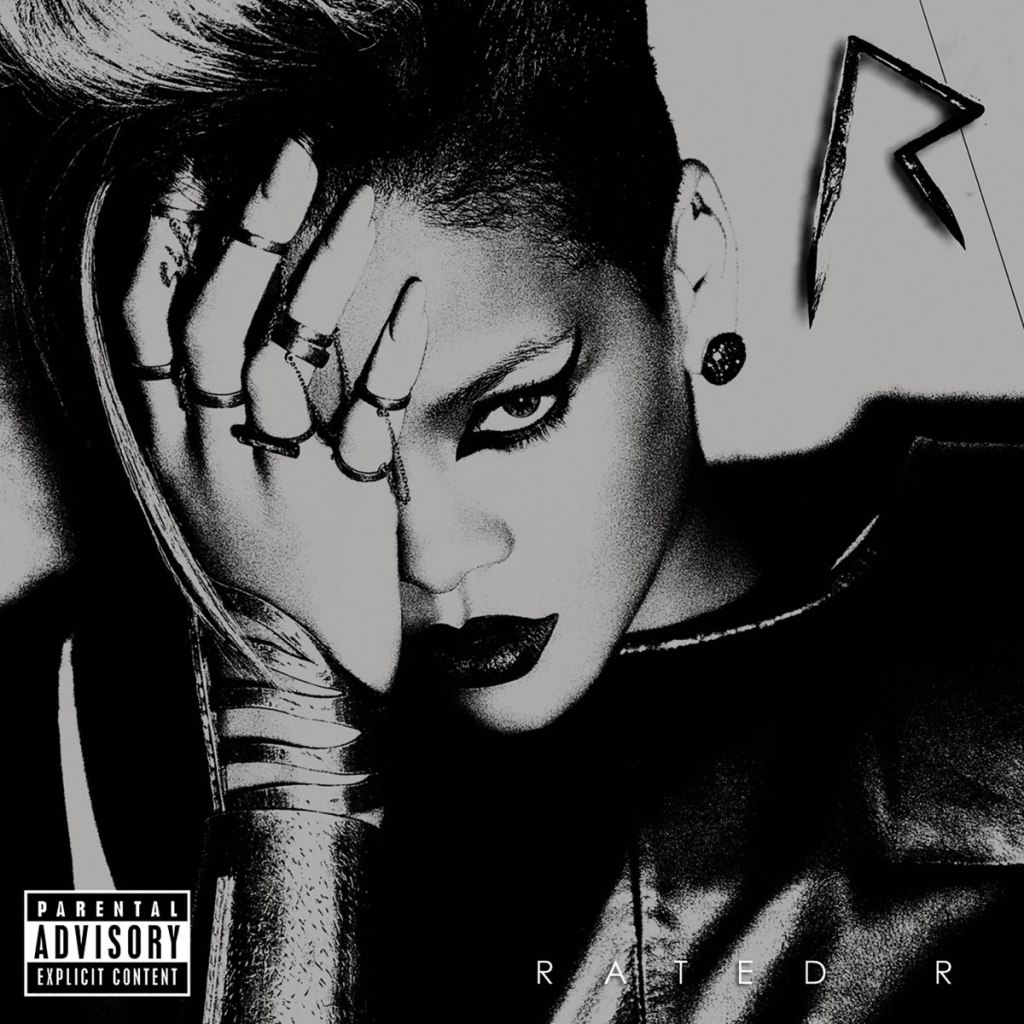
The Ellen Von Unwerth black-and-white photoshoot marked a clear visual break from her previous image. It presented a version of Rihanna that was harder, more stylized, and less immediately approachable. This shift complicated the dominant narrative: instead of conforming to expected expressions of victimhood, she projected anger, control, and distance. The shaved hairstyle further reinforced this transformation, becoming a visual symbol of rupture rather than continuity.
The sonic identity of “Rated R” aligns closely with this reconfigured image, marking a clear departure from her previous work. The soundscape is colder and more metallic, enhancing her vocal delivery.
Chase & Status, chosen for this album, incorporate elements of dubstep on “Wait Your Turn,” while a part of the production uses electronic textures to create a harder persona on the intro “Mad House” or on songs like “G4L”.
The lyrical content of “Rated R” reflects a marked shift in tone. On tracks like “Rockstar 101,” Rihanna adopts a more aggressive stance, declaring, “I’ll never be the victim, I’d rather be the stalker.” Yet, the other half of the album sees her delve into R&B-inflected ballads that could be perceived as colder, and that address a failed and abusive relationship on songs like “Stupid in Love” and “Cold Case Love”.
The identity is not conflicted, but the sentiments presented are more complex and varied. While refusing to become the representative of domestic violence, she presents her point of view through the album.
Visually, the era reinforces this shift. The imagery released around November is darker than her previous material. While darker tones had been used for editorial effects on “Good Girl Gone Bad”, here they become central to the narrative. Black-and-white palettes and blue lighting are used to reinforce the image she constructs at the time.
“Russian Roulette” presents several ways of being killed. “Hard” places her in a military landscape, avoiding bombs in a desert. The “Wait Your Turn” visual presents her in black and white, in a church and in a deserted parking structure.
The reception of these darker, more introspective tracks proved uneven, particularly in the United States. While “Russian Roulette” reached the top ten, peaking at number nine, this still marked a relative decline compared to the string of higher-charting hits she had accumulated before. For an artist who had quickly established herself as a consistent hitmaker, this signalled a shift in how her music was being received.
In response, the label pivoted toward the album’s most playful track, “Rude Boy.” Drawing on dancehall influences, the song reintroduced a lighter and more rhythmic energy, with a tone that is clearly sensual and playful, something that had not been used as centrally in her singles before, aside from “Break It Off,” which did not receive a video.
The timing of the release is also notable. Issued in February, earlier than the usual spring window for this type of track, it suggests a form of urgency in pivoting the album’s trajectory.
The strategy proved effective. “Rude Boy” became the album’s major commercial success, ensuring that “Rated R” maintained a presence within the charts. However, this pivot also revealed a tension in audience reception. The darker, more confrontational aspects of the project were less embraced, while the return to a more carefree and danceable sound was more successful.
This response reflects a broader cultural context. In the aftermath of the 2008 financial crisis, mainstream pop consumption started leaning heavily toward escapism. Club-oriented music, parties, and forms of collective release became dominant, while more introspective or unsettling material struggled to resonate in the same way. In this environment, “Rated R”F’s emotional directness and tonal severity may have felt misaligned with the kind of release audiences were seeking.
Rihanna – Music of the Sun
Rihanna – A Girl Like Me
Rihanna – Good Girl Gone Bad
Rihanna – Rated R
 Elemental Emancipation
Leave a comment